
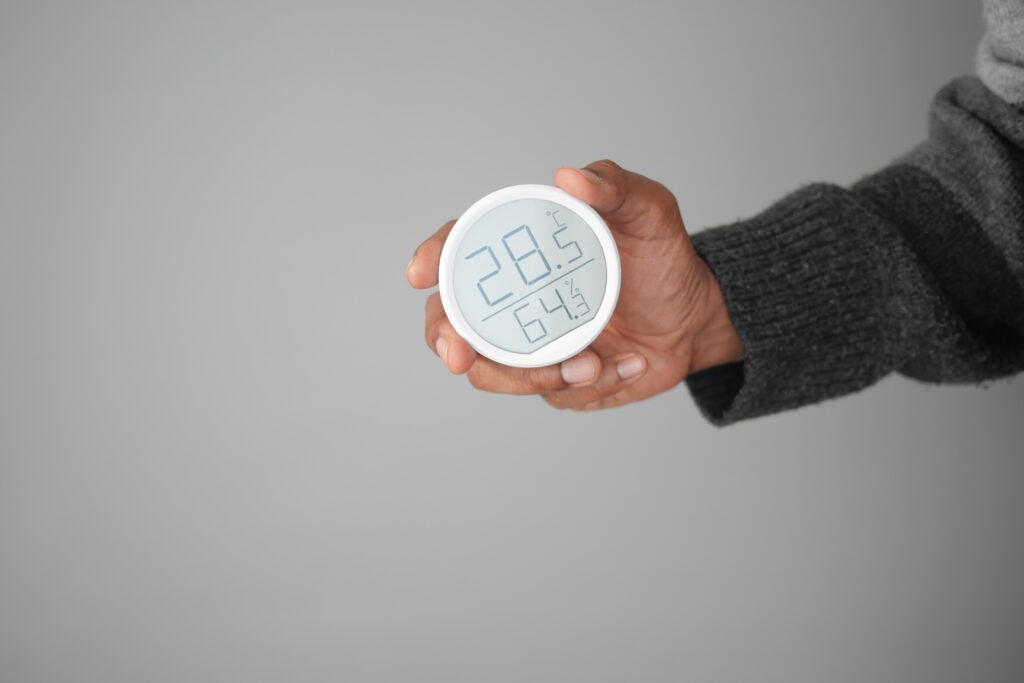
A temperature and humidity sensor for your home
Sensors are the eyes, ears, and nerves of the electronic world. These elements detect and respond to physical inputs from their environment, such as light, heat, motion, pressure, or moisture, and convert them into electrical signals that can be read and interpreted by a microcontroller or other electronic system. From the accelerometer in a smartphone that detects screen orientation to the temperature sensor in a smart thermostat, sensors are the critical link between the physical world and digital data.
Integrating these components into a product requires accurate, verified CAD data to translate the sensor’s function into a reliable, manufacturable PCB. Sourcing a complete and correct sensor CAD model is a foundational step for any successful IoT, industrial, or consumer electronics design.
The world of sensors is vast, with devices designed to measure nearly any physical phenomenon imaginable. They can be broadly categorized by what they measure, but they share a common underlying architecture and function.
| Common Sensor Types and Applications | ||||
| Type | Measures | Examples | Applications | Operating Principle |
| Physical | Mechanical or environmental properties | Temperature , pressure , acceleration, distance, flow rate | Common in industrial and automotive systems | Physical changes (e.g., expansion, force, motion) are converted to electrical signals via resistive, capacitive, piezoelectric, or inductive effects. |
| Chemical | Chemical composition or concentration | Gas sensors, pH sensors, biosensors | Often used in environmental monitoring and medical devices | Chemical reactions or interactions produce a voltage or current change proportional to the analyte concentration. |
| Optical | Light or radiation | Photodiodes, phototransistors, image sensors | Used in cameras, optical encoders, and proximity detection | Incident light generates electron-hole pairs, producing a current or voltage signal that is proportional to the light intensity. |
| Magnetic/Electric | Magnetic/electric fields, current | Hall effect sensors , magnetometers, capacitive touch sensors | Used for position sensing, current monitoring, and touch interfaces | Magnetic or electric fields induce a measurable change in voltage, current, or capacitance in the sensor. |
Regardless of the type, most sensors are complex systems-in-a-package that include several integrated stages
When selecting a sensor, designers should consider key functional parameters to ensure performance.
Unlike typical ICs, which are often standardized in size and package, sensors can vary significantly in shape and construction depending on what they measure. This diversity makes having the correct CAD model even more critical. An accurate sensor CAD model ensures proper connection and integration, allowing the device to function correctly and consistently within the system.
Sourcing accurate CAD data can be challenging, but Ultra Librarian addresses this by offering a single platform containing millions of electronic components, including a growing library of sensors from leading manufacturers.
| Key Features of the Ultra Librarian CAD Library: | |
| Feature | Description |
| Single Source of Truth | Verified sensor symbols, footprints, and 3D models are available in one place, all linked to the manufacturer part number to ensure complete data integrity. |
| Standards-Compliant Data | Footprints adhere to IPC standards, reducing the risk of manufacturing errors and eliminating the need for time-consuming manual checks. |
| Universal ECAD Support | Models are provided in native formats for all major ECAD tools, eliminating the need for error-prone format conversions. |
| Integrated Supply Chain Info | Each sensor CAD model includes live sourcing data from global distributors, covering pricing, stock availability, and lifecycle status, connecting design decisions directly to the supply chain. |
When searching for sensor CAD models, Ultra Librarian allows filtering by manufacturer, distributor, or CAD model type. Each sensor model is linked to its manufacturer part number, making it easy to cross-reference with procurement and simulation data.

Ultra Librarian enables filtering by manufacturers, distributors, or CAD model type
For instance, the TE Connectivity HPP801A031 humidity sensor is available at Ultra Librarian, complete with a set of resources including symbol, footprint, and 3D model. Footprints can be viewed in Basic or Detailed mode, giving designers flexibility in examining the layout.
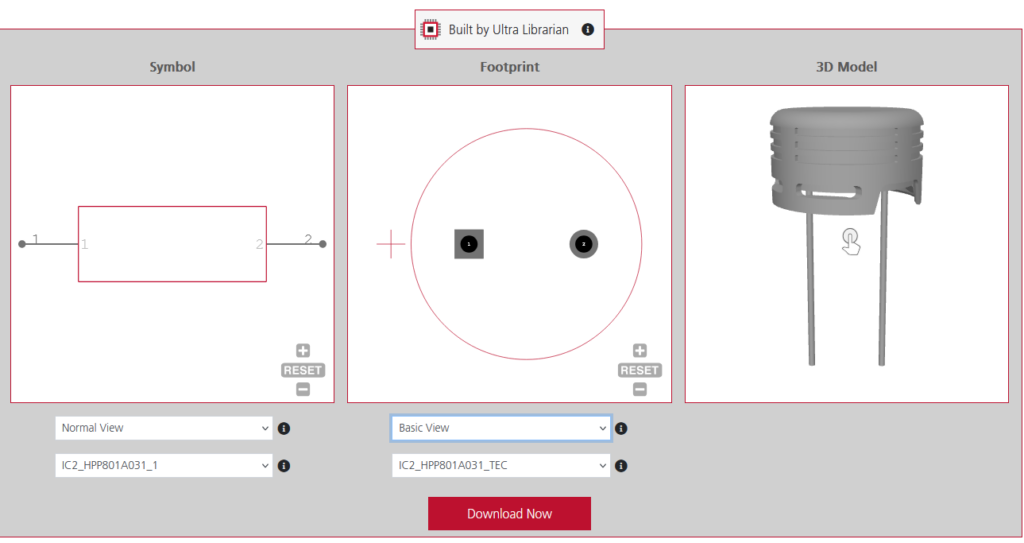
TE Connectivity HPP801A031 humidity sensor model on Ultra Librarian
Models can be downloaded directly in your preferred ECAD format. Ultra Librarian also allows customization of symbol pin ordering (Sequential or Functional) and unit selection (mil or mm), ensuring seamless integration into PCB designs.
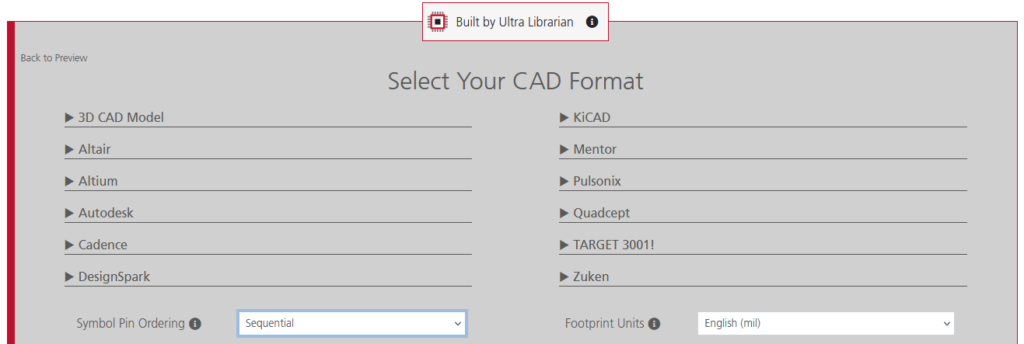
Download your Sensors CAD model in any ECAD format you need
If you’re looking for CAD models for your sensor, Ultra Librarian helps by compiling all your sourcing and CAD information in one place. You can download sensor CAD models in popular ECAD application formats from worldwide distributors.
Working with Ultra Librarian sets your team up for success, ensuring streamlined and error-free design, production, and sourcing. Register today for free.