

Like an alphabet, combining electronic components in different orders and combinations unlocks different functionality. These components are at the heart of any simulation or schematic design, but deciphering their broader physical characteristics from a symbol of thousands can be daunting. Designers new to circuit board layout or those wishing to review these features can use this electronic component guide as a handy reference.
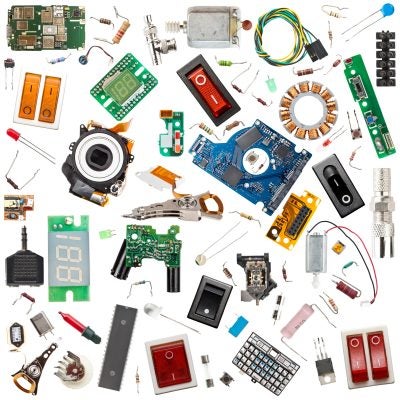
Electronic components come in many shapes, sizes, and functions – like
an LED, this electronic component guide offers illumination.
| ELECTRONIC COMPONENTS GUIDE BREAKDOWN | |||
| Common Components | Passive/Active? | Linear? | Semiconductor?* |
| Resistor | Passive | Yes | No |
| Capacitor | Passive | Yes | No |
| Inductor | Passive | Yes | No |
| Diode | Passive | No | Yes |
| Transistor | Active | No | Yes |
| Integrated Circuit (IC) | Both | Depends | Yes |
Electronic components begin with the three essential passive components: the resistor, capacitor, and inductor. In the classic water analogy, where the current is the speed of the flowing water, voltage is a waterfall, and resistance is a rock, log, or other object residing in the river, the three passives directly correlate. A resistor offers resistance to the current flow (e.g., the rock or log example), a capacitor acts like a water storage tank, and an inductor is like a water wheel that maintains the inertia of the flowing water. Subsequently (translating back to the world of electronics), the resistor opposes the flow of electrons by dissipating power in the form of heat, a capacitor stores energy in the form of an electric field (it opposes a change in voltage by sourcing current), and an inductor stores energy in the form of a magnetic field (it opposes a change in current by sourcing voltage).
Consider some additional details on these essential passive components:
Each of these passive components individually offers an indispensable circuit function, but combined resistors, inductors, and capacitors provide vast filter networks for signal integrity. The four essential filters – highpass, lowpass, bandpass, and bandstop – all use some permutation of resistors, capacitors, and inductors from the source to the load.
Additional Passive Components | |
Oscillator | A quartz crystal or ceramic material provides a reliable periodic signal for timing. |
Fuse | A sacrificial component that protects sensitive circuits/components from overcurrent conditions by failing and creating an open in the circuit continuity. |
Antifuse | An antifuse is a redundant component that shorts to preserve circuit continuity. |
Switch | Electromechanical components that control circuit behavior by toggling between two or more electrical contacts. |
Semiconductors are another major class of components that created the digital revolution in electronics over the past seven decades. Semiconductors span active and passive components and largely account for the power consumption/size reduction and speed increase in modern devices. Broadly, semiconductor devices are any whose primary functionality derives from the properties of semiconductor materials like silicon, germanium, gallium nitride, or gallium arsenide (to name a few). Consider some of the major families of semiconductor devices:
Achieving the highest level of PCBA development requires optimizing your PCB layout and design process by understanding and incorporating important considerations; such as how your selection of electronic components affects all aspects of board development.
Designers can use an electronic component guide to acclimate to component function and performance as these characteristics often shape layout requirements (e.g., manufacturer’s datasheets). The first step to translating any electronic design to a board layout is creating the footprints that enable assembly between the bare board and selected components. Looking to streamline your footprint creation process?
The next stage of your PCBA design is to convert the schematic to a PCB layout. Similar to drawing the schematic, this stage includes choosing materials, routing, and design verification. Again, for the most efficient process and highest quality results, it is best to follow good design guidelines, including the ones listed below.
The guidelines above can be used for any PCBA design, and following the items on the list will help your CM maximize the first pass yield rate for your board build process. However, the overall success of your board development and the quality of the design and manufacturing processes is dependent upon having and following an accurate and effective electronic component guide and the electronic components you choose.
If you’re looking for CAD models for common electronic components or design tips to help improve the efficiency of your PCB layout, Ultra Librarian helps by compiling all your sourcing and CAD information in one place. Working with Ultra Librarian sets up your team for success to ensure streamlined and error-free design, production, and sourcing. Register today for free.