Design-led distribution connects component manufacturers with engineers early in the schematic capture phase.Electronic component distribution channels connect semiconductor manufacturers and the engineers who actually build products. If your channel strategy is wrong, your parts will never make it onto a schematic — no matter how good the silicon is.
The global electronic components market was valued at $428.22 billion in 2025 and is projected to grow at a 10% CAGR through 2034. That trajectory represents an enormous opportunity, but only for manufacturers whose components are discoverable, accessible, and design-ready at every stage of the engineering workflow. Relying on traditional, transaction-based fulfillment alone leaves most of that opportunity on the table.
What Electronic Component Distribution Channels Actually Do
A distribution channel, at its core, is any pathway through which a manufacturer’s components reach the engineers and procurement teams who use them. Distributors act as intermediaries who buy components in bulk and sell to customers, offering a range of products, support, and flexible payment options. But that description covers only the traditional model — and the traditional model is no longer sufficient.
Distribution in 2026 is no longer just about parts. The engineers defining tomorrow’s system architectures are selecting components during schematic capture, not during procurement. By the time a purchase order is raised, the design-in decision has already been made — often weeks or months earlier. Manufacturers who engage only at the procurement stage are competing for a seat at a table they weren’t invited to.
The shift toward design-led distribution addresses this directly. Rather than waiting for a BOM to be finalized, design-led channels embed manufacturers into the engineering discovery process from the start.
Channel Type
Primary Engagement Phase
Key Value Proposition
Typical Conversion Metric
Traditional Fulfillment
Procurement / Scaling
Volume availability and pricing
PO Volume / Revenue
Design-Led Distribution
Architecture Definition
Technical consulting and FAE support
Design Wins / BOM Placement
Digital Platforms (CAD)
Schematic Capture
Frictionless design integration
Model Downloads / Integrations
Why Digital Channels Are Now the Primary Discovery Mechanism
Online distribution channels grew 25% in 2024, reflecting a broad shift toward digital procurement models. That growth isn’t just about purchasing; it reflects where engineers go to evaluate and select parts in the first place.
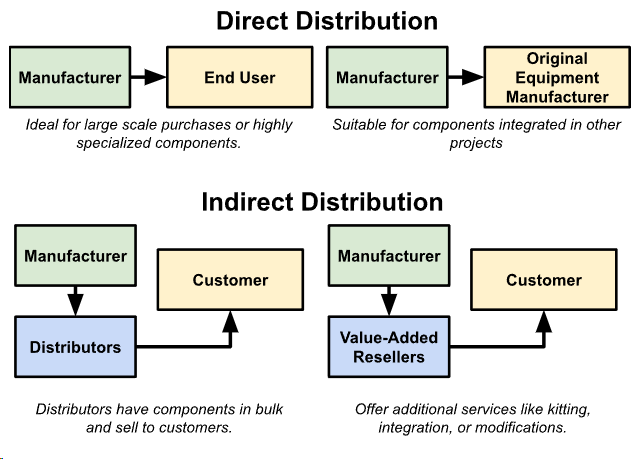
Direct Distribution
Manufacturer → End User: Components are sold directly to companies using them in their systems. This model is common for high-volume or specialized components where configuration control, supply guarantees, or performance requirements are critical.
Manufacturer → OEM: IC manufacturers supply components directly to original equipment manufacturers that integrate them into finished products such as automotive systems, telecom infrastructure, or medical devices.
Indirect Distribution
Distributors: Authorized distributors purchase components in bulk and resell them to a broad customer base. They provide large catalogs, logistics support, inventory availability, and flexible purchasing options for engineering teams and procurement departments.
Value-Added Resellers (VARs): VARs distribute components while adding services such as component kitting, custom integration, assembly support, or preconfigured design kits tailored for specific applications.
There are multiple options for manufacturers’ distribution strategies.
Today’s hardware engineer doesn’t wait for a field applications engineer to show up with a demo board. They search parametrically, filter by package and operating temperature, pull a datasheet, and, if the component has a ready-to-use CAD model, drop it into their schematic. The entire evaluation can be completed in under 10 minutes. There are major challenges in connecting with the engineers who determine whether to implement a specific manufacturer’s components. Today, engineers rely on multiple sources to learn about new components, so manufacturers must develop effective strategies for the marketing channels their target audience uses.
Key digital channel requirements for IC manufacturers include the following:
Parametric completeness: Every voltage threshold, operating temperature, and package variant must be accurately indexed in distributor search engines
Lifecycle visibility: Active, NRND, and Obsolete status must be clearly flagged — engineers designing with deprecated silicon create downstream supply chain problems for everyone
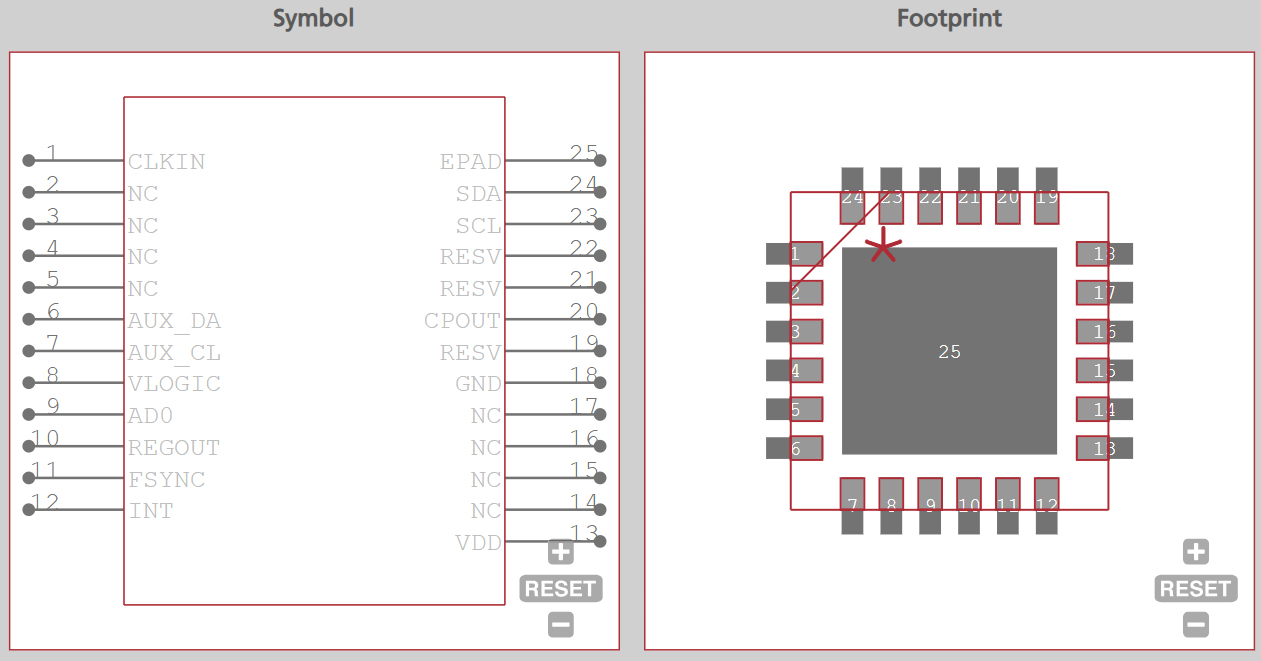
CAD model availability: Schematic symbols, PCB footprints, and 3D STEP models must be present and verified before the part shows up in a search result
Reference designs: Application-level design examples that demonstrate real-world implementation accelerate evaluation and reduce engineering risk
How Ultra Librarian Fits Into the Channel Strategy
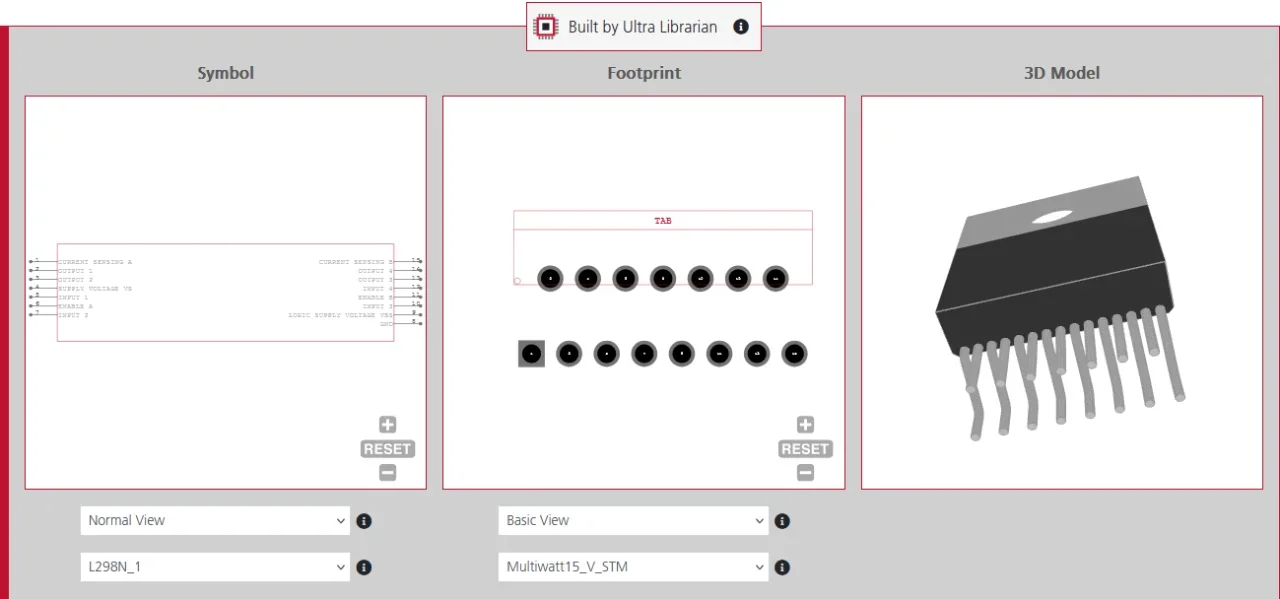
Ultra Librarian is the world’s largest provider of electronic component libraries, offering manufacturer-verified CAD models, PCB footprints, and schematic symbols for use in electronic design automation (EDA) tools. Engineers can search over 16 million verified symbols, footprints, and 3D models, browse intelligent reference designs from participating manufacturers, and find associated documentation, including datasheets, pricing, availability, and simulation models.
Ultra Librarian integrates directly into EDA workflows to put your parts directly on the engineer’s canvas.
For IC manufacturers, that scale matters strategically. Library parts can be exported to over 20 EDA CAD formats, providing schematic symbols, PCB footprints, and 3D models, meaning a single verified model upload reaches engineers working across Altium, OrCAD, KiCad, and every other major design environment simultaneously.
To ensure accuracy, consistency, and adherence to IPC standards, models undergo more than 30 verification checks before publication. All parts are created in accordance with globally recognized industry standards, including IPC-7351 (PCB footprints), ANSI Y32.3-1975 (schematic symbols), and ISO 10303-21 (STEP models). That verification layer matters to engineers — a footprint error that slips through to fabrication costs far more than the time it takes to verify the model upstream.
The manufacturer-side benefits are equally concrete:
Frictionless design integration: Engineers place verified parts directly from within their EDA tool without leaving the design environment. With Ultra Librarian built directly into OrCAD, engineers can search, preview, and place parts with a simple drag-and-drop, or download components to their library for future designs.
Analytics and engagement data: Ultra Librarian enables manufacturers to understand how engineers discover and evaluate their components through model downloads and design integrations. These interactions provide insight into which parts engineers are actively evaluating while enabling manufacturers to reach engineering audiences through targeted marketing programs, newsletters, webinars, and other engagement channels.
Global reach, no FAE required: Ultra Librarian helps manufacturers showcase products through featured placements, search optimization, and targeted advertising that reaches engineers during the critical component selection phase, with 185,000+ emailable contacts in the database.
Converting Visibility Into Design Wins
Brand awareness in engineering channels is a means to an end. The actual metric that matters is the design-in conversion, the moment a downloaded model becomes a committed component on a production BOM.
Understanding how your audience thinks and delivering the data they want are the first keys to effective engagement with engineers. Equally important is having a digital presence that easily links to a procurement resource. The path from model download to purchase order must be frictionless. Any gap in that chain, such as a missing distributor link, an unverifiable lifecycle status, or an inaccurate parametric entry, creates an exit point where engineers select a competitor’s part instead.
Every stage of the digital procurement process must be seamless to ensure high design-in conversion rates.
Three factors directly drive design-in conversion rates:
Data accuracy at the point of discovery — Parametric errors in distributor databases cause your part to disappear from filtered search results. Regular audits of how your components appear across distributor platforms are non-negotiable.
Model quality — An inaccurate 3D STEP model that causes a mechanical clearance violation on the board will get the part replaced, even after it’s been schematically committed. Physical dimensions must match the datasheet exactly.
Application context — Reference designs and application notes that show the component solving a real problem give engineers confidence to commit. A bare footprint with no application context is a starting point; a reference design is a closing argument.
The traditional and online distributors segment is expected to command 40.5% of market share by 2035, driven by the growth of e-commerce channels, digital procurement platforms, and hybrid distribution models. Manufacturers who invest now in digital channel presence are positioning ahead of that consolidation, not reacting to it.
A Structured Approach to Channel Optimization
Auditing and upgrading your market access strategy doesn’t require rebuilding everything at once. Execute these steps in sequence:
Build verified digital twins for every active SKU. Every component in your portfolio needs an accurate, verified schematic symbol, PCB footprint, and 3D STEP model hosted on platforms like Ultra Librarian. A part without a CAD model is effectively invisible to the schematic-capture workflow.
Audit parametric data quarterly. Search your own parts in distributor databases the same way an engineer would, including voltage range, package type, and operating temperature. If any of these values are indexed incorrectly, your part is dropped from the filtered results.
Track model downloads and correlate with sample requests. Download analytics are a leading indicator of design-in activity. A spike in downloads for a specific part, followed by a lag in sample requests, signals a conversion bottleneck worth investigating.
Ensure lifecycle transparency. Clear Active/NRND/Obsolete status indicators prevent engineers from designing in parts you’re planning to discontinue. Incorrect status is a problem that harms both your customer relationships and your reputation in the design community.
Electronics manufacturers are doubling down on supply chain resilience, with customers in North America and Europe increasingly favoring distributors that offer local responsiveness and flexible delivery. The manufacturers who will capture disproportionate share in this environment are those who make it easiest for engineers to find, evaluate, and commit to their components at every stage of the design cycle.
Ready to transform how engineers discover and design-in your parts? Evaluating your current electronic component distribution channels is the first step toward securing more placements early in the design cycle. Partner with Ultra Librarian to ensure your verified CAD models reach engineers globally across popular ECAD applications and through our network of worldwide distributors.
Working with Ultra Librarian sets your team up for success, ensuring streamlined and error-free design, production, and sourcing. Contact UltraLibrarian for partnership opportunities.
Ultra Librarian offers the world’s largest PCB CAD library, putting cutting-edge materials at your fingertips so you can build better products faster—all for free.
Join Our Newsletter
Subscribe to our newsletter to receive the latest news, and important updates
If you’re looking for any of our component footprints or models, we have readily available and free options for you and your design team. Search our library for the solution you’ve been looking for.
Working with us allows you to target the right audience for your component, provide content to nurture them along their design process, and analyze how your parts are being received and used.
Ultra Librarian is the worlds largest online – and always free – PCB CAD library. Build products better, faster, and more accurately with easy access to vendor-verified symbols, footprints, and 3D models. Register today to start searching the right components for your next design.







 If you’re looking for any of our component footprints or models, we have readily available and free options for you and your design team. Search our library for the solution you’ve been looking for.