Composed of diodes, rectifiers are commonly used basic electronic devices that convert alternating current (AC) into direct current (DC). A diode behaves like a one-way valve, allowing current to flow in a single direction. Rectifiers play an important role in numerous devices and power supply systems, providing unidirectional electric current, which is essential for the operation of electronic components. The 1N4007 rectifier serves as a common default choice for many hardware projects.
If an electronics designer reviews the 1N4007 diode datasheet, the document shows exactly why the part remains heavily used. The 1N4007 diode handles high voltages easily, costs very little to manufacture, and its silicon junction is easy to implement. This article explains the core electrical specifications, explores the related product family, and details specific circuit applications for the 1N4007 diode.
Decoding the 1N4007 Diode Datasheet
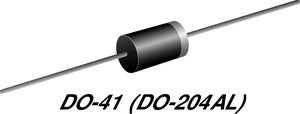
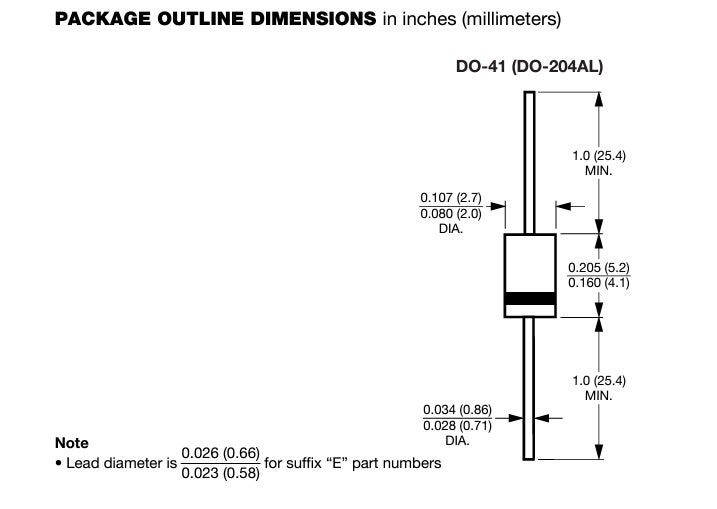
Understanding limits and electrical boundaries prevents circuit failure. The component uses a DO-41 package, which is a small black cylinder with two metal axial leads:
- The unmarked lead acts as the anode
- The lead at the end, marked with a silver band, acts as the cathode
Current flows from the anode toward the cathode. The physical dimensions typically measure 5.2 millimeters in body length and 2.7 millimeters in diameter.
The data table below lists the primary electrical limits.
Primary 1N4007 Diode Specifications
| Parameter | Symbol | Value | Unit |
| Average Rectified Current | Io | 1.0 | A |
| Peak Repetitive Reverse Voltage | VRRM | 1000 | V |
| Peak Forward Surge Current (8.3 ms) | IFSM | 30 | A |
| Maximum Forward Voltage | VF | 1.1 | V |
| Typical Thermal Resistance | RθJA | 50 | °C/W |
| Operating Junction Temperature | Tj | -55 to +150 | °C |
Engineers might expect a 1-ampere diode to handle exactly 1 ampere continuously without issue. In reality, thermal resistance causes the silicon to heat up very quickly. At 1 ampere, the diode has a forward voltage drop of approximately 1 volt, meaning it dissipates about 1 watt of power as heat. Because the device has a typical thermal resistance of 50 °C/W, that 1-watt load can raise the junction temperature by roughly 50 °C above the surrounding ambient temperature.
For this reason, designers must account for heat dissipation when planning the printed circuit board (PCB) layout and surrounding copper area. In particular, look for validated footprints that include accurate pad dimensions and copper area data, so that thermal planning starts from a verified baseline rather than a manual transcription of the datasheet.
Additionally, note the peak forward-surge current rating of 30 amperes. A 30-ampere rating sounds excessively high for a 1-ampere component. However, such a surge rating matters during system startup. When a power supply first turns on, empty filter capacitors act like a short circuit. As a result, the empty capacitors draw a massive inrush current for a few milliseconds, and it’s important that the diode can withstand the initial surge without melting.
Comparing the 1N400x Series
The 1N4007 belongs to a larger family of standard rectifiers. Consequently, the series spans from the 1N4001 through the 1N4007. The main difference involves the peak repetitive reverse voltage. The reverse voltage rating dictates how much backward electrical pressure the part can withstand before breaking down.
Reverse Voltage Ratings by Part Number
| Part Number | Peak Repetitive Reverse Voltage (VRRM) | RMS Reverse Voltage |
| 1N4001 | 50V | 35V |
| 1N4002 | 100V | 70V |
| 1N4003 | 200V | 140V |
| 1N4004 | 400V | 280V |
| 1N4005 | 600V | 420V |
| 1N4006 | 800V | 560V |
| 1N4007 | 1000V | 700V |
Note that each part in the series handles 1 ampere of forward average current. So, why would an engineer buy the 1N4001 when the 1N4007 blocks much higher voltage? Historically, engineers factored junction capacitance into part selection.
The 1N4001 carries a typical junction capacitance of 15 pF, while the 1N4007 measures approximately 8 pF at 4 V and 1 MHz, according to manufacturer specifications. A higher reverse-voltage rating widens the internal depletion region, which reduces capacitance. Lower junction capacitance means less signal distortion at higher frequencies, which gave the higher-voltage 1N4007 a slight performance edge in those applications.
Today, however, modern manufacturing methods often make the internal silicon pieces nearly identical across the series. That’s why many assembly houses simply stock the 1000-volt version, the 1N4007. The 1000-volt device easily handles all standard mains alternating-current voltage applications. Buying a single part in bulk saves money, and builders do not need to track multiple part numbers during assembly.
Common Circuit Applications For The 1N4007 Diode
According to the 1N4007 diode datasheet, the component is well-suited for low-frequency power applications. Hardware designers use the device in several standard configurations.
- Bridge Rectifiers: Four rectifiers arranged in a diamond pattern convert a full alternating current wave into pulsating direct current. During the positive half-cycle, two diodes conduct. During the negative half-cycle, the other two diodes conduct. The arrangement keeps current flowing to the load in one direction. Power supplies use a bridge rectifier just after the main step-down transformer.
- Reverse Polarity Protection: Connecting a single diode in series with a power input blocks reverse current. If a user installs a battery backward, the diode prevents current from flowing. The blockage prevents damage to sensitive microchips.
- Flyback Protection: Inductive loads, such as relays or motors, store energy in a magnetic field. Turning off the power causes the magnetic field to collapse rapidly. The rapid collapse of the magnetic field induces a large voltage spike across the coil terminals (V = L × di/dt). Placing a diode in parallel with the inductive load provides a freewheeling path for this energy to dissipate safely. The diode protects the main switching transistor from high-voltage destruction.
The 1N4007 handles the tasks well. However, the component features a standard recovery time. Standard recovery means the semiconductor turns off slowly. When the voltage reverses, the diode continues conducting backward for a few microseconds. Fast-switching circuits will require different parts.
1N4007 Diode Alternatives and Substitutes
Circuit requirements sometimes exceed the limits of a standard recovery rectifier. As a result, engineers often swap the default part for specific alternatives.
- UF4007: The letters stand for ultra-fast. Like the 1N4007, the UF4007 is rated for 1000 V reverse voltage and 1 A average forward current, but it offers a much shorter reverse recovery time. This faster switching reduces power losses and switching noise, making the UF4007 a better choice for high-frequency applications such as switch-mode power supplies (SMPS), where standard rectifiers like the 1N4007 recover too slowly.
- 1N5408: Heavy loads require more current. The 1N5408 handles 3 amperes of continuous current and uses a thicker DO-201AD package. The thicker metal leads dissipate heat better.
- 1N5819: Low-voltage battery circuits need high efficiency. The 1N5819 is a Schottky diode. A Schottky diode offers a lower forward voltage drop of around 0.45 volts. The lower drop saves battery power. The tradeoff is a maximum reverse voltage of only 40 volts.
- M7 or S1M: Modern printed circuit board assembly requires surface-mounted parts. The M7 and S1M act as surface-mount equivalents to the standard axial part. Both parts sit in a compact surface-mount A-size (SMA) package. Each of these alternatives has a different footprint, and rebuilding a CAD model from scratch for every swap adds up fast. For reference, Ultra Librarian carries validated models for all of them, which you can download directly into your CAD tool.
1N4007 PCB Assembly (PCBA) Design Essentials
Turning a schematic symbol into a physical board layout requires careful planning: It starts with the DO-41 package, which is typically mounted horizontally on the printed circuit board. The axial leads are bent downward to pass through the drilled holes, then secured with wave soldering or another through-hole soldering process.
From there, designers should consider a few critical steps:
- Review footprint design. Through-hole pad diameters of approximately 1.0 to 1.2 millimeters provide adequate clearance for the leads, while standard lead spacing is typically 10.16 millimeters.
- Double-check dimension measurements. An incorrect footprint can mean scrapped boards and thousands of dollars in wasted product. Using a manufacturer-validated CAD model from Ultra Librarian eliminates that risk before the design ever reaches fabrication.
- Consider thermal management during the layout process. The copper traces connected to the diode help dissipate heat, so wider traces can improve thermal performance by conducting heat away from the package.
- Ensure adequate spacing between nearby heat-generating components. For example, placing four rectifiers too closely together in a bridge configuration causes each device to absorb heat from its neighbors, increasing operating temperatures. Providing additional spacing promotes better airflow, reduces thermal stress, and helps extend the overall lifespan of the circuit.
Engineers rely on standard silicon rectifiers for everyday power conversion tasks, and reviewing the 1N4007 diode datasheet is essential to ensure safe electrical operation within rated limits. However, sourcing accurate footprint data, verified 3D models, and reliable schematic symbols across popular electronic computer-aided design (ECAD) applications and worldwide distributors can be time-consuming, too. Search Ultra Librarian to access the 1N4007 diode datasheet quickly, trusted CAD models, and complete part information, helping you move from design to PCB layout faster and with greater confidence.
Working with Ultra Librarian sets your team up for success, ensuring streamlined and error-free design, production, and sourcing. Register today for free.

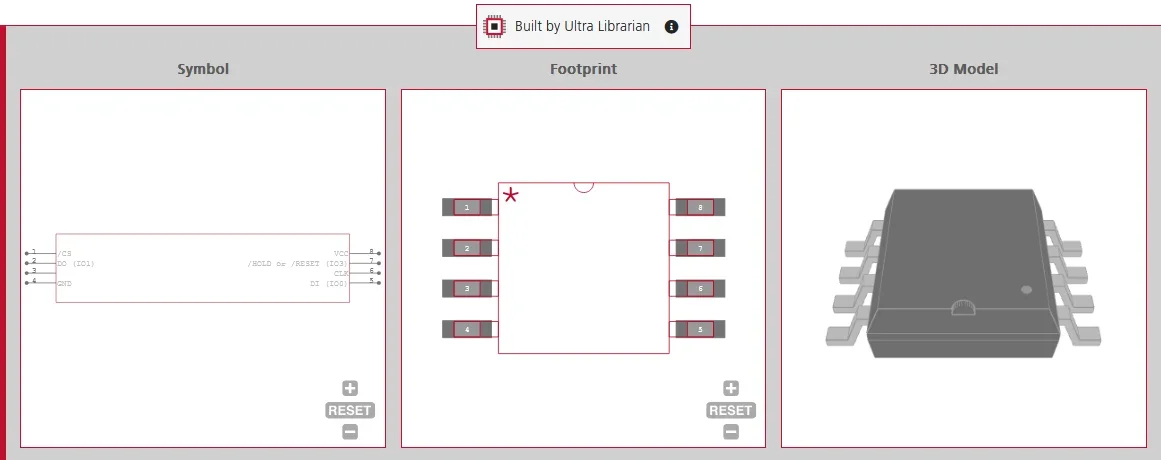
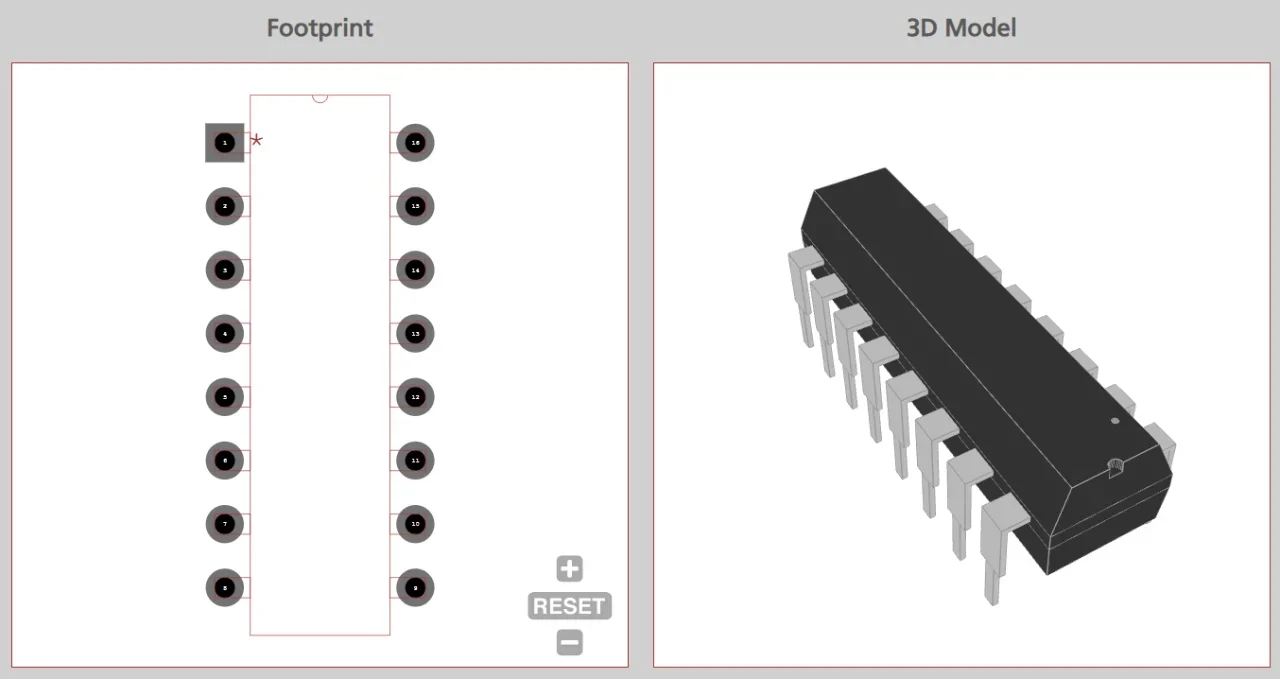
 If you’re looking for any of our component footprints or models, we have readily available and free options for you and your design team. Search our library for the solution you’ve been looking for.