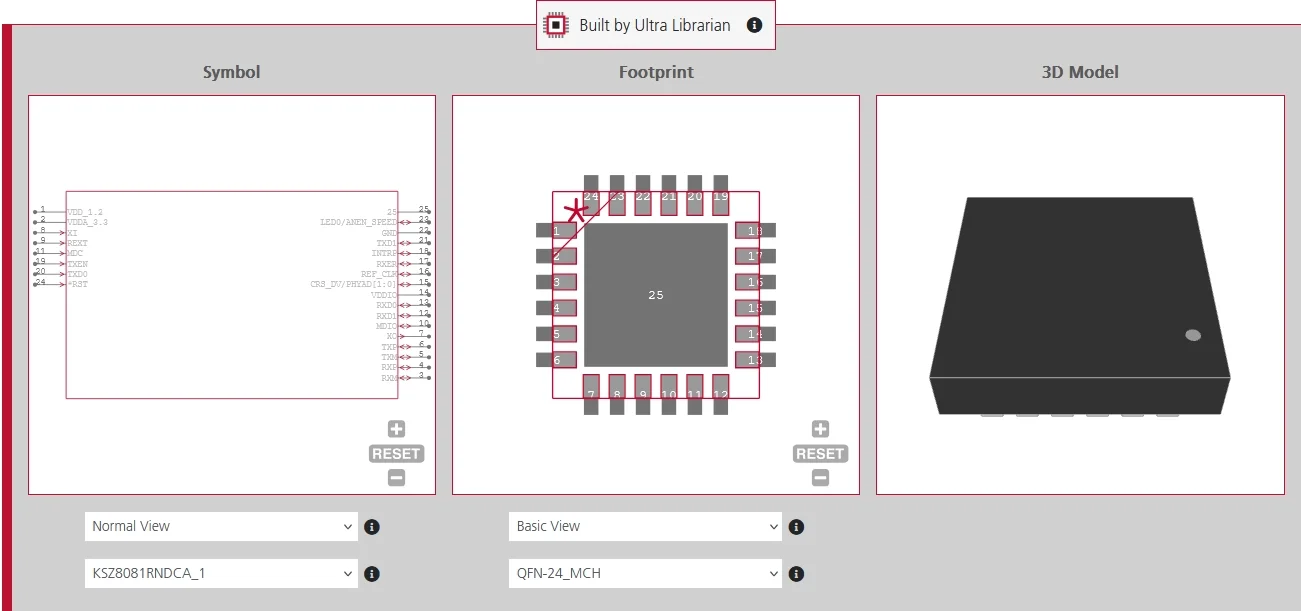
Symbol, Footprint, and 3D Model of STM32F1
The STM32 family from STMicroelectronics is arguably the most popular 32-bit microcontroller ecosystem in the world. With over 1,000 part numbers ranging from ultra-simple 8-pin devices to 1GHz multi-core behemoths, there is an STM32 for almost any application. However, that versatility creates a challenge: paralysis by analysis. This STM32 microcontroller selection guide provides a framework to help you categorize device families, evaluate key selection criteria, and quickly finalize your decision. Complementing this process, Ultra Librarian now integrates with STMicroelectronics’ STM32CubeMX application, allowing users to customize the pinout of their selected STM32 device.
Categorizing the STM32 Portfolio
To simplify selection, ST groups their MCUs into four primary categories.
1. Mainstream (Cost-Effective & Balanced)
These are general-purpose workhorses designed for cost-sensitive applications that still require 32-bit performance.
- Families: STM32F0, STM32G0, STM32C0.
- Best For: Simple motor control, consumer appliances, industrial interfaces, and replacing 8-bit/16-bit legacy MCUs.
- Highlight: The STM32C0 is the entry-level series, bridging the gap between 8-bit cost and 32-bit architecture.
2. High-Performance (Processing Power & Integration)
These MCUs feature faster cores, DSP instructions, and rich connectivity, making them ideal for data-intensive tasks.
- Families: STM32F4, STM32F7, STM32H7, STM32H5.
- Best For: Advanced motor control, digital signal processing (DSP), edge AI, rich graphics (GUIs), and industrial gateways.
- Highlight: The STM32H7 offers dual-core options (Cortex-M7 + M4) running up to 550MHz, capable of handling real-time OS (RTOS) and heavy computation simultaneously.
3. Ultra-Low-Power (Battery & Energy Harvesting)
Optimized for energy efficiency, these chips feature advanced sleep modes and efficient peripherals.
- Families: STM32L0, STM32L4, STM32U5.
- Best For: Wearables, medical devices, smart meters, and battery-powered IoT nodes.
- Highlight: The STM32U5 is a flagship low-power MCU with an autonomous background mode (LPBAM) that allows peripherals to function while the core sleeps.
4. Wireless (Integrated Connectivity)
System-on-Chip (SoC) solutions that combine an MCU with a radio transceiver.
- Families: STM32WB (Bluetooth/Zigbee), STM32WL (LoRaWAN), STM32WBA.
- Best For: Connected home devices, asset tracking, and smart building infrastructure.
Comparison of Common STM32 Families
| Series | Category | Core Architecture | Max Speed | Best Suited For |
| STM32C0 | Mainstream | Arm Cortex-M0+ | 48 MHz | Entry-level cost, replacing 8-bit/16-bit MCUs. |
| STM32G4 | Mainstream | Arm Cortex-M4 | 170 MHz | Digital power, motor control, and mixed-signal apps. |
| STM32F4 | High-Performance | Arm Cortex-M4 | 180 MHz | The industry standard for DSP, audio, and sensor hubs. |
| STM32H7 | High-Performance | Arm Cortex-M7 / M4 | 550 MHz | Edge AI, industrial gateways, complex GUIs. |
| STM32L4+ | Ultra-Low-Power | Arm Cortex-M4 | 120 MHz | Smart meters, medical devices, fitness bands. |
| STM32U5 | Ultra-Low-Power | Arm Cortex-M33 | 160 MHz | Secure wearables (TrustZone), advanced IoT nodes. |
| STM32WB | Wireless | Arm Cortex-M4 / M0+ | 64 MHz | Bluetooth LE, Zigbee, and Thread connectivity. |
STM32 Microcontroller Selection Guide
Once you have identified the broad category, use this checklist to refine your STM32 microcontroller selection guide:
Performance (Core & Speed)
Do you need raw math power?
- Cortex-M0+: Sufficient for basic control and I/O handling (Mainstream).
- Cortex-M4/M33: Includes FPU (Floating Point Unit) and DSP instructions (Performance/Low Power).
- Cortex-M7: Highest performance for complex algorithms and high-speed data processing.
Memory Configuration
- Flash: How large is your firmware? Do you need Over-the-Air (OTA) updates? (Double the flash size if OTA is required).
- RAM: Does your application require large buffers for graphics, TCP/IP stacks, or AI models?
Peripheral Integration
External components increase BOM cost. Look for on-chip integration:
- Analog: 12-bit vs. 16-bit ADCs, internal op-amps, and comparators.
- Connectivity: CAN FD for automotive, USB-C/PD, Ethernet MAC, or simple I2C/SPI.
- Security: Cryptographic accelerators, secure boot, and TrustZone (available on Cortex-M33 devices like STM32L5/H5).
Decision Framework: A Step-by-Step Approach
- Define the Power Constraint: Is it battery-powered? If yes, start with the L or U series. If wired, look at the F or G series.
- Estimate Code Size: Choose a Flash density. Ensure the family you pick has a pin-compatible migration path if you need to upgrade memory later.
- Identify “Must-Have” Peripherals: If you need a USB PHY or Ethernet MAC, this immediately filters out 80% of the options.
- Check Availability & Lifecycle: Ensure the specific part number (MPN) is active and has a long-term supply commitment (typically 10 years for ST).
- Use the STM32CubeMX: Ultra Librarian has a new integration with the STM32CubeMX application, where users can filter for specific STM32 devices and define custom pin names in STM32CubeMX to match specific functions, then download Ultra Librarian symbols and models that are automatically personalized to that exact pinout through the Ultra Librarian widget.
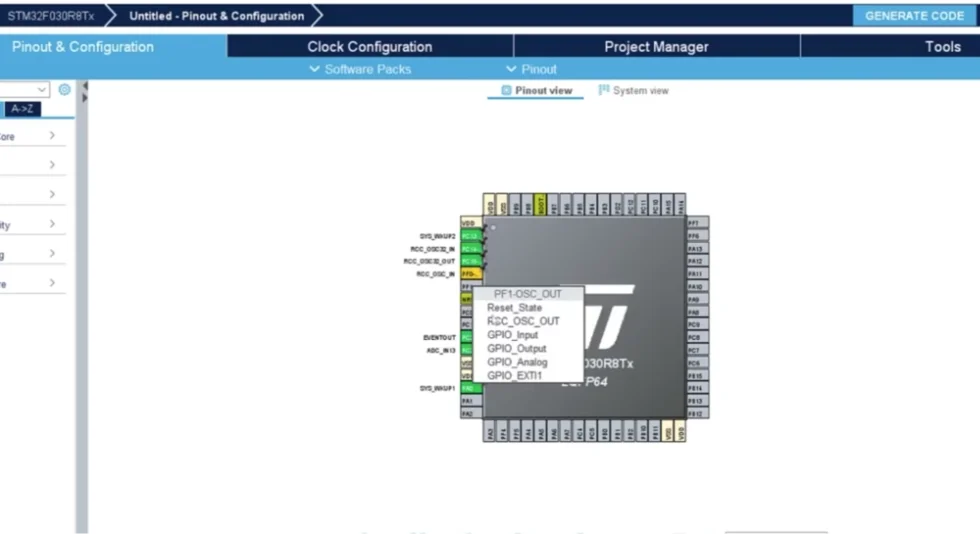 STM32CubeMX allows users to customize the pinout and export it in different formats
Real-World Use Cases and Tips
- Smart Thermostat (GUI + Wireless): An STM32WB handles the Bluetooth connection to the phone, while an STM32G0 might handle the simple display and relays (or a single high-end WB could do both).
- Industrial Motor Drive: An STM32G4 is specifically tailored for this, featuring high-resolution timers and math accelerators (CORDIC) for vector control.
- Fitness Tracker: An STM32U5 provides the processing power for sensor fusion (accelerometer/heart rate) while maintaining weeks of battery life through deep sleep modes.
Integration Tips
- Using STM32CubeMX: Ultra Librarian now integrates with the STM32CubeMX application, allowing users to filter for specific STM32 devices and define custom pin names in STM32CubeMX to match specific functions, then download Ultra Librarian symbols and models that are personalized to that exact pinout through the Ultra Librarian widget.
- Prototyping: Use low-cost Nucleo or Discovery boards to prototype your code on real silicon before finalizing your PCB.
- Plan for Migration: One of ST’s strengths is pin-compatibility. Design using standard footprints (e.g., LQFP64) to allow for seamless upgrades. This lets you swap a cost-effective STM32G0 for a powerful STM32G4 later without redesigning the board.
- Future-Proofing: Verify the 10-Year Longevity commitment status for supply chain security. Additionally, prioritize chips with hardware security features, such as TrustZone (found in L5/U5/H5 series), to ensure compliance with upcoming cybersecurity regulations.
By following a structured STM32 microcontroller selection guide, you can navigate the STM32 ecosystem efficiently. Always start with the power and performance requirements, filter by critical peripherals, and leverage the STM32Cube ecosystem to validate your choice before committing to hardware. If you’re looking for CAD models for the STM32 microcontroller, Ultra Librarian helps by compiling all your sourcing and CAD information in one place.
Working with Ultra Librarian sets your team up for success by ensuring streamlined and error-free design, production, and sourcing. Register today for free.

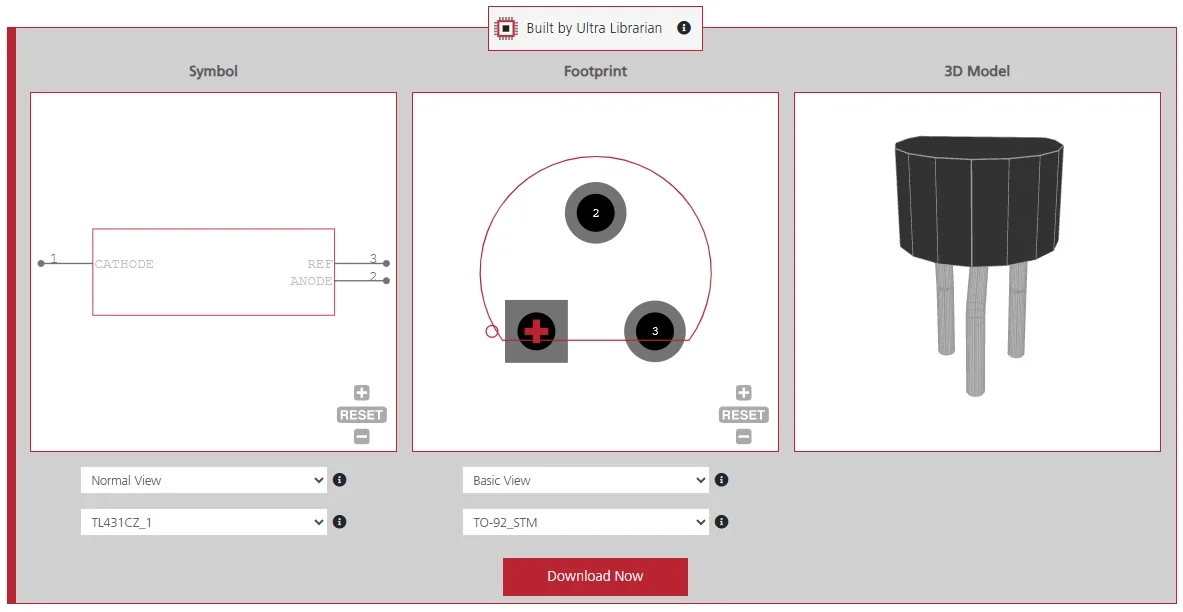
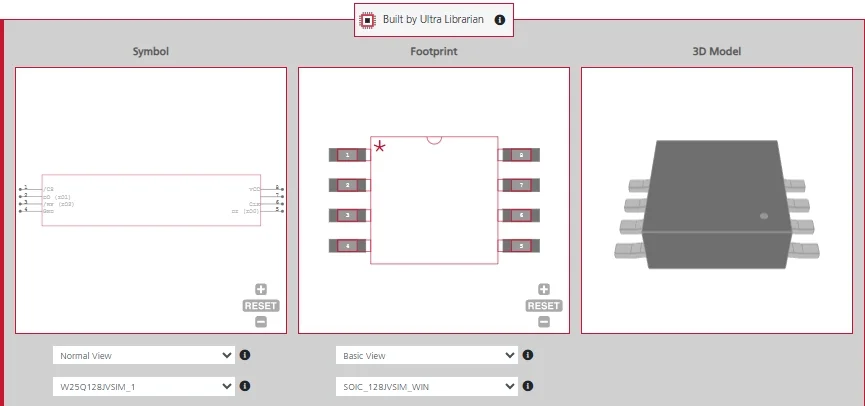
 If you’re looking for any of our component footprints or models, we have readily available and free options for you and your design team. Search our library for the solution you’ve been looking for.