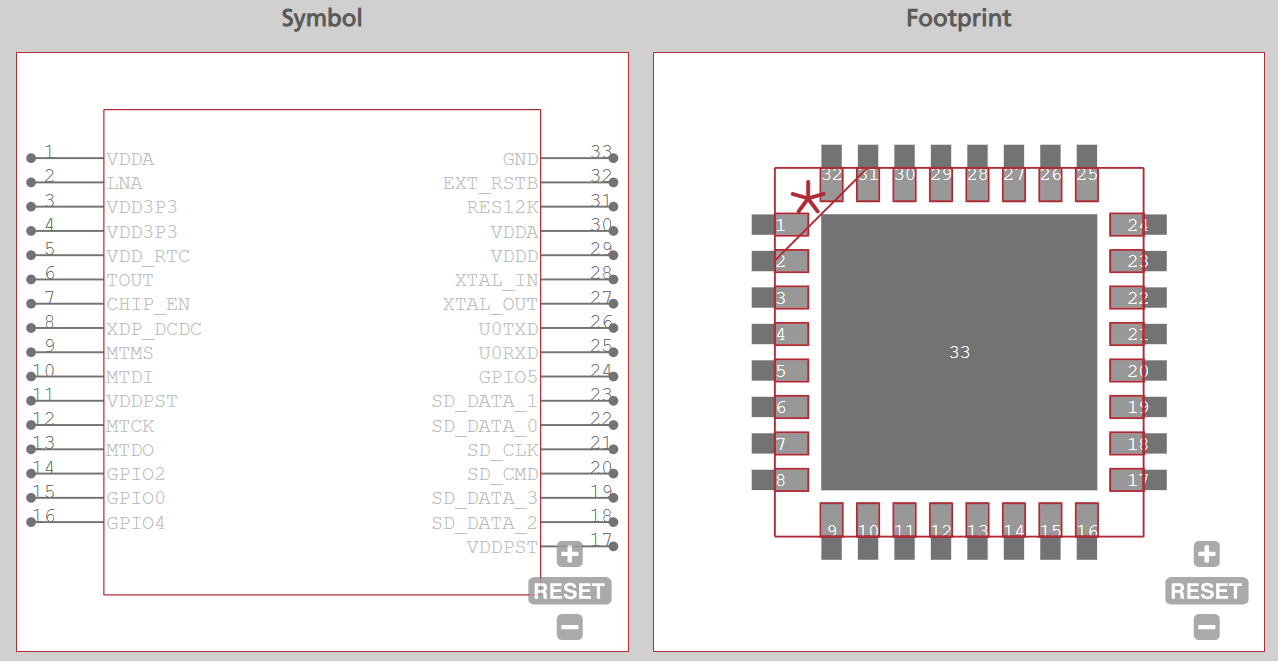
CAD data for the ESP8266EX from Ultra Librarian
The ESP8266 is a compact Wi-Fi microchip used to bring wireless connectivity to embedded systems and Internet of Things (IoT) products. It enables microcontrollers to communicate over local networks or the internet, whether that’s for reading sensors, pushing data to the cloud, or controlling devices remotely.
The ESP8266 was, and for many, still is, a fantastic piece of silicon. It gained rapid popularity since 2014, particularly with the ESP-01 module, due to its ability to connect microcontrollers to Wi-Fi networks using simple AT (Attention) commands. These standardized text instructions are used to configure and control the module’s network functions over a serial communication interface. For tasks like controlling a relay over Wi-Fi, reading a basic sensor, or creating a simple web server, the ESP8266 has been the go-to for years.
However, the ESP8266’s single-core architecture, limited RAM, and the complete absence of Bluetooth have become significant constraints as IoT applications grew in complexity and demanded more diverse connectivity. As an obsolete component, this piece will examine the best options for ESP8266 equivalent components.
The ESP8266 features:
- A Tensilica L106 32-bit RISC (Reduced Instruction Set Computing) microprocessor running at 80 MHz, though it could be overclocked to 160 MHz.
- It typically offered around 160 KB of RAM (32 KB of instruction RAM and 96 KB of data RAM, with approximately 50 KB of user-available RAM on some modules) and supported external QSPI flash memory, commonly 4 MB on development boards.
- It was built for 802.11 b/g/n Wi-Fi, with an integrated TCP/IP stack.
- Peripherals included 17 General Purpose Input/Output (GPIO) pins, SPI, I2C (software-implemented), I2S, UART, and a single 10-bit Analog-to-Digital Converter (ADC).
Key Criteria for Modern ESP8266 Equivalents
When evaluating these criteria, several modern components stand out as strong ESP8266 equivalents. Each balances processing performance, connectivity, and ecosystem maturity in its own way. In the following sections, we’ll look closely at the most prominent successors.
ESP32: Improved ESP8266 Equivalent
Espressif Systems, the creators of the ESP8266, also developed its highly successful successor: the ESP32 family. The ESP32 maintains Wi-Fi capabilities while addressing many of the ESP8266’s limitations head-on, including higher processing power and expanded memory.
ESP32-WROOM-32E (The “Standard” ESP32)
The ESP32-WROOM-32E is the most direct successor and often the go-to alternative. If you’re currently using an ESP8266 and need more performance and flexibility, this is likely where you’ll land first.
- Processor: Dual-core Tensilica Xtensa LX6 processor, capable of running at up to 240 MHz. This represents a significant leap from the single-core 80-160 MHz of the ESP8266, enabling more complex applications and multitasking.
- Memory: Typically comes with 520 KB of SRAM, an increase over the ESP8266’s roughly 160 KB of on-chip RAM, providing space for larger programs and data buffering.
- Connectivity: It features both 2.4 GHz Wi-Fi (802.11 b/g/n) and dual-mode Bluetooth (Classic Bluetooth and Bluetooth Low Energy 4.2). Such dual-mode capability opens up a world of possibilities for local communication.
- Peripherals: Offers 34 GPIOs, significantly more than the ESP8266’s 17. It also includes 18 12-bit ADC channels (compared to the ESP8266’s single 10-bit ADC), two 8-bit DACs, capacitive touch sensors, and more robust I2S support.
- Security: Includes hardware security features like AES encryption, secure boot, and flash encryption.
- Ecosystem: Espressif IDF, Arduino core, and MicroPython support.
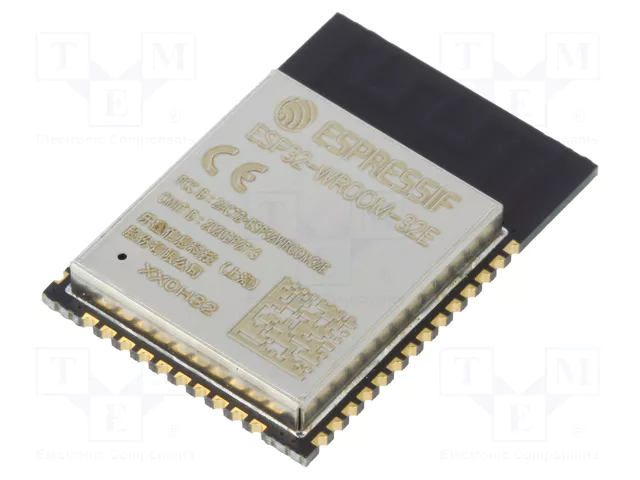
ESP32-WROOM-32E module for Wi-Fi and Bluetooth-enabled IoT applications
ESP32-S2: For HMI and Wi-Fi Applications
The ESP32-S2 family offers a slightly different take on the ESP32 architecture:
- Use Case: Ideal for human-machine interface (HMI) applications, display controllers, and any Wi-Fi-connected device where strong security and USB connectivity are important, but Bluetooth isn’t needed.
- Processor: Single-core Xtensa LX7, up to 240 MHz, with a ULP co-processor. While single-core, the LX7 is a more efficient architecture.
- Memory: 320 KB SRAM, 128 KB ROM, and 16 KB RTC SRAM, with support for external flash and PSRAM.
- Connectivity: Features 2.4 GHz Wi-Fi (802.11 b/g/n), but notably lacks Bluetooth. This makes it less of a direct “equivalent” if Bluetooth is a requirement, but perfect for Wi-Fi-only applications needing advanced features.
- Peripherals: 43 programmable GPIOs, 20 channels of 13-bit SAR (Successive Approximation Register) ADCs, 2 DACs, and a full-speed USB OTG interface. The USB OTG is a standout feature, enabling it to act as a USB host or device directly.
- Security: Strong hardware security, including cryptographic accelerators (AES, SHA, RSA), RNG, HMAC, Digital Signature modules, flash encryption, and secure boot.
ESP32-S3: Next-Level ESP8266 Replacement The ESP32-S3 expands on the S2 platform with greater performance, memory, and AI capabilities. It features a dual-core Xtensa LX7 CPU running at up to 240 MHz, equipped with a floating-point unit and vector instructions for machine-learning acceleration. A RISC-V ultra-low-power co-processor efficiently handles background tasks. The chip includes 512 KB of internal SRAM and supports up to 1 GiB of external Octal SPI flash and PSRAM. Wireless connectivity covers 2.4 GHz Wi-Fi (802.11 b/g/n) and Bluetooth 5 LE with long-range and 2 Mbps modes. With 45 GPIOs, it supports SPI, I²C, I²S, PWM, ADC, UART, SD/MMC, TWAI™ (CAN-bus), USB OTG, and camera input. Hardware security is extensive, featuring AES-XTS flash encryption, RSA secure boot, digital signature, and HMAC modules, as well as Espressif’s “World Controller” for isolated execution. |
ESP32-C3: RISC-V Powered Yet Cost-Effective
The ESP32-C3 is a more recent addition to the family, noteworthy for its adoption of the open-source RISC-V instruction set architecture. It’s designed to be a cost-effective and energy-efficient option that still offers Wi-Fi and Bluetooth capabilities, making it a strong contender for many ESP8266 replacement scenarios.
- Use Case: A solid, cost-effective choice for general IoT tasks, smart home devices, and applications where a single core is sufficient, and both Wi-Fi and modern Bluetooth are needed without breaking the bank.
- Processor: Single-core 32-bit RISC-V processor, up to 160 MHz. This is closer to the ESP8266’s clock speed but with a more modern architecture.
- Memory: 400 KB of internal SRAM. Modules often include 4MB of flash.
- Connectivity: Integrates 2.4 GHz Wi-Fi (802.11 b/g/n) and Bluetooth 5 (LE) with long-range support. This combination is excellent for many general IoT applications.
- Peripherals: Offers around 22 configurable GPIOs, which is fewer than the standard ESP32 but still more flexible than the ESP8266. It includes standard interfaces like SPI, I2C, UART, and PWM.
- Security: Strong security features, including RSA-3072-based secure boot and AES-128/256-XTS-based flash encryption, along with digital signature and HMAC peripherals.
- Power Consumption: Designed for low-power operation, making it suitable for battery-powered devices.
Other ESP8266 Alternatives
While the ESP32 family dominates the “ESP8266 Equivalent” conversation due to direct lineage and ecosystem familiarity, other players offer compelling options depending on your project’s specific needs: specifically, the Raspberry Pi Pico W and the Nordic nRF52/nRF53 series.
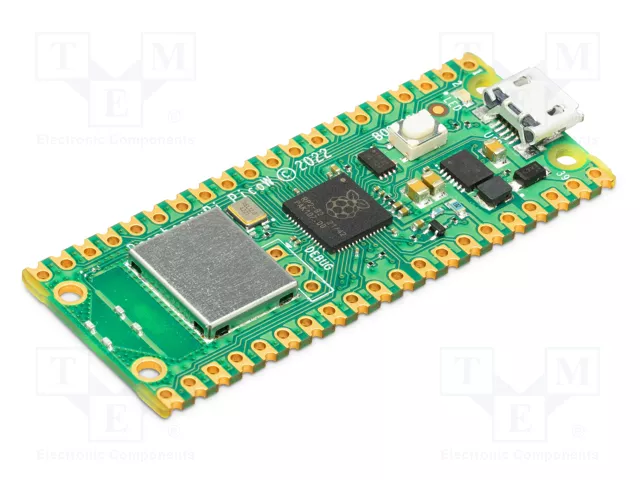
Raspberry Pi Pico W board


 If you’re looking for any of our component footprints or models, we have readily available and free options for you and your design team. Search our library for the solution you’ve been looking for.