It happens to every engineering team. After months of perfecting a PCB layout with clean traces, stable power, and solid thermal performance, purchasing sends the dreaded email: the main controller is out of stock, on a 52-week lead time, or is suddenly end-of-life. Supply chain volatility makes sourcing obsolete and hard-to-find ICs a constant headache for modern design teams. It feels like an unsolvable puzzle at times. Actually, it is solvable, but it takes a shift in how we approach electronic component sourcing. We have to look at the root causes before we can fix the symptoms.
Why Are There More Obsolete Electronic Components Than Ever
Foundries are aggressively reallocating production capacity to advanced sub-3nm nodes to meet surging demand from artificial intelligence and high-performance computing. This transition reduces wafer allocations for older legacy nodes, especially the 90nm and 180nm processes. Legacy nodes remain critical for industrial, automotive, and defense applications, but the economics of semiconductor manufacturing now heavily favor the leading edge. The result: part availability for mature product lines is shrinking faster than most engineering teams anticipate.
Regulatory pressure is compounding the problem. The European Union’s Restriction of Hazardous Substances (RoHS) and Registration, Evaluation, Authorization and Restriction of Chemicals (REACH) directives are continuously tightening, and expiring exemptions are forcing end-of-life (EOL) decisions on legacy parts that were never expected to go obsolete this soon. These specific changes deserve attention right now:
- RoHS Exemptions 7(c)-I and 7(c)-II: Critical exemptions for lead solder, brass connectors, and ceramic capacitors expire July 21, 2026. Specifically, Exemption 7(c)-II (covering lead in dielectric ceramic capacitors for rated voltages of 125 V AC or 250 V DC and above) has been extended until December 31, 2027. Still, manufacturers should monitor renewal status closely, as these exemptions are extended until December 31, 2027, though the expiry date is currently suspended due to a renewal request submitted in December 2025.
- REACH SVHC Expansion: As of November 5, 2025, ECHA added one additional substance to the REACH Candidate List, bringing the total to 251 Substances of Very High Concern (SVHCs). Each addition triggers new compliance obligations and can render legacy parts non-conforming with little warning.
When regulatory deadlines collide with constrained manufacturing capacity, electronic component sourcing stops being a procurement task and becomes an engineering competency.
Building Obsolescence Resilience Before You Need It
The engineers who have never scrambled sourcing obsolete and hard-to-find ICs in their designs aren’t lucky; they’ve built resilience into their bill of materials (BOM) before the first prototype ships. Waiting for a procurement manager to flag a shortage is the reactive model. By then, your options are limited, your timeline is compressed, and the gray market starts looking tempting.
A robust Approved Vendor List (AVL) is your first line of defense. Pre-approving two or three pin-compatible alternatives from different manufacturers eliminates the qualification delays that turn a shortage into a crisis. Pair that with lifecycle analysis tools that predict EOL risk years in advance, and you stop reacting to the supply chain and start managing it.
Sourcing Obsolete and Hard-to-Find ICs: Reactive vs. Proactive Component Sourcing
| Strategy | Reactive Sourcing | Proactive Sourcing |
| BOM Management | Single-source parts specified; alternatives found only after a shortage hits. | 2-3 pre-approved alternatives on the AVL before production begins. |
| Distributor Network | Relies on one primary vendor; resorts to unverified brokers during shortages. | Multiple authorized global distributors are used to guarantee authentic, traceable stock. |
| Obsolescence Tracking | Waits for manufacturer EOL notification emails. | Lifecycle analysis tools flag at-risk parts years before EOL announcements. |
| Redesign Impact | High probability of forced PCB layout changes and delayed time-to-market. | Low probability of delays due to pre-verified footprint and functional compatibility. |
Key practices that separate proactive teams from reactive ones:
- Diversify your distributor network by adding at least two authorized global distributors for each high-risk component category.
- Run parametric cross-reference searches at design time to identify form, fit, and function replacements before they’re needed.
- Build safety stock for components with historically volatile lead times (legacy microcontrollers and specialized analog front-ends are the usual offenders).
- Monitor regulatory calendars for RoHS exemption renewal deadlines and REACH SVHC additions that could affect your BOM.
TME: Authorized Inventory at Global Scale
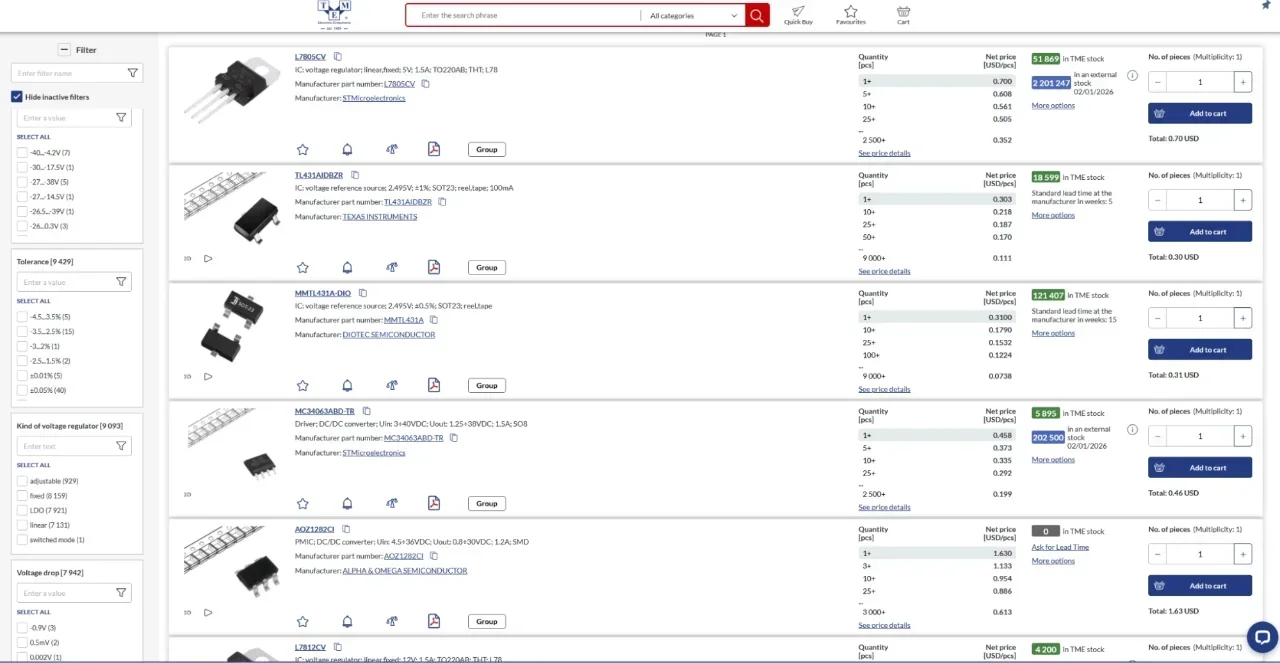
Scale and traceability are what separate a useful distribution partner from a risky one during a shortage. Transfer Multisort Elektronik (TME) addresses both. TME maintains an active inventory of more than 1,000,000 products sourced from over 1,400 suppliers through authorized channels, ensuring every part has a traceable lineage back to the original manufacturer. That traceability is the entire point when you’re trying to stay out of the gray market.
TME serves 280,000 customers in over 150 countries. With a modern warehouse and optimized logistics, TME processes 5,200 shipments daily, ensuring fast and reliable delivery. When you locate a replacement part, you can have it on your loading dock within days, not weeks.
To use TME effectively during an active component shortage, follow this sequence:
- Extract the critical parameters from your current datasheet: operating voltage range, package type, pinout, and key electrical specifications.
- Run a parametric search against TME’s catalog to filter for exact functional matches.
- Verify stock depth and lead time to confirm the alternative part has sufficient inventory to cover your full production run, not just a prototype quantity.
- Order through the authorized channel to guarantee authenticity and maintain full traceability documentation for your compliance records.
From Sourced Part to Placed Footprint: Where Ultra Librarian Closes the Loop
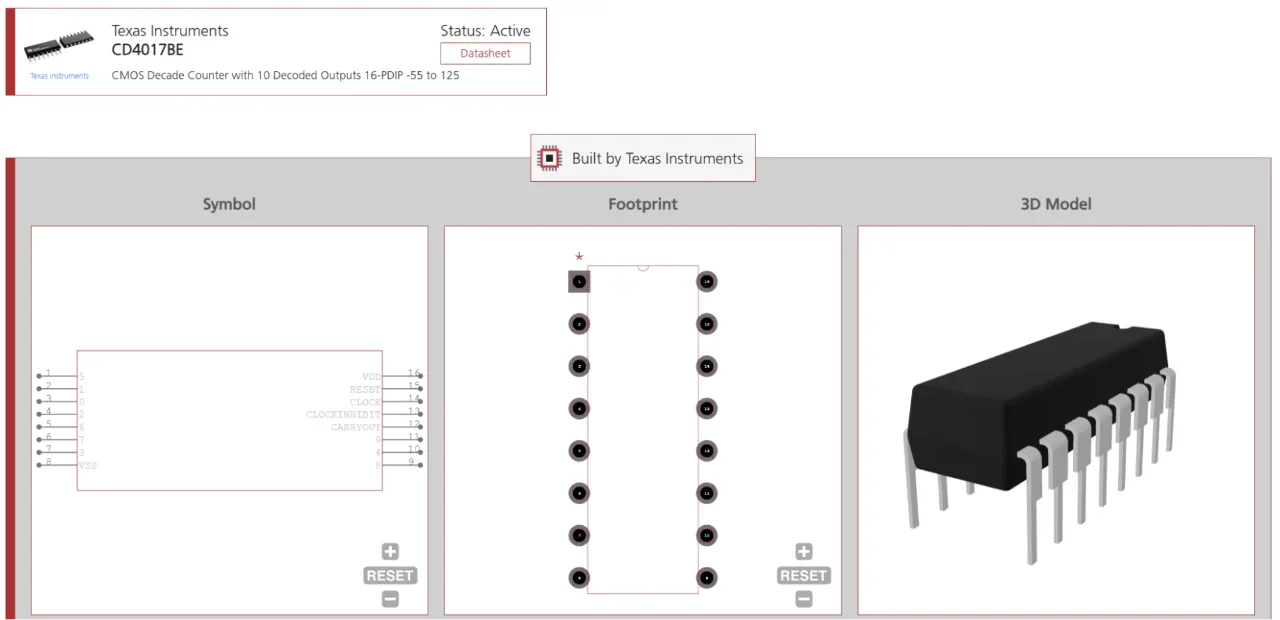
Finding the physical replacement part solves half the problem. The other half is getting that part into your design without introducing errors. Manually building schematic symbols, PCB footprints, and 3D models for replacement components is time-consuming and error-prone — a misaligned pad or incorrect pin assignment discovered after board fabrication is an expensive mistake.
Ultra Librarian bridges the gap between procurement and design by providing instant access to verified CAD models for millions of components. When you identify a viable replacement on a distributor site like TME, you can immediately download the corresponding symbol and footprint and drop it directly into Altium Designer, Cadence Allegro, KiCad, or your electronic design automation (EDA) tool of choice. The physical part you ordered will match the copper pads on your fabricated board because the model was built from the manufacturer’s verified data, not reconstructed by hand.

Ultra Librarian provides Instant access to verified footprints and symbols across major EDA platforms, eliminating the risk of manual errors during a component swap.
The practical benefit compounds over time. More specifically, when your team pre-qualifies alternative parts during the design phase and links each one to a verified CAD model, a future shortage becomes a straightforward swap rather than a multi-week scramble. Accordingly, aligning BOM decisions with available CAD data early is one of the few supply chain risk-reduction moves that costs you nothing at design time and pays off every time a part goes scarce.
Ready to stop reacting to the supply chain and start managing it proactively? Ultra Librarian helps you seamlessly match verified CAD models to available components, so you’re not stuck with unavailable or sourcing obsolete and hard-to-find ICs. We integrate directly with popular ECAD applications and connect you to worldwide distributors to ensure your team never scrambles for a footprint again.
Working with Ultra Librarian sets your team up for success, ensuring streamlined and error-free design, production, and sourcing. Register today for free.


 If you’re looking for any of our component footprints or models, we have readily available and free options for you and your design team. Search our library for the solution you’ve been looking for.