In 2011, Netflix was streaming full seasons to living room televisions. In the same year, if an engineer needed a 10µF ceramic cap in an 0805 footprint, the best available option was still scrolling through pages of a digital catalog or calling a sales rep to narrow it down.
Today, that process has been transformed by powerful search tools, but the evolution of component sourcing is far from over. The search process, for example, has lagged far behind the complexity of modern designs, despite the fact that the technology to filter parts by specification has existed commercially since at least the late ’90s.
The reason that progress remained slow was not purely technical; finding electronic components has always been kept just hard enough to keep engineers dependent on the people selling them. Understanding that pattern is the key to understanding where component search is headed next.
Finding Electronic Components: Every Era’s Gatekeepers
There’s a consistent divide in how people describe the component search problem.
- Those on the sales side of the industry tend to call it solved: parametric search exists, after all.
- Electrical engineers who use it daily tend to disagree. Finding the right part is a significant time sink, and the tools have not kept pace with the complexity of modern designs.
When you look at history, the same dynamic repeats. Each era of component search was shaped by whoever controlled the information, and each transition happened only when the cost of maintaining that friction finally became unbearable.
The Shopkeeper’s Eye (1921–1948)
Finding electronic parts began in 1921 on Radio Row in lower Manhattan. More than 400 shops crammed into a few blocks of Cortlandt Street, Radio Row was where you went to buy vacuum tubes, resistors, and every kind of electronic part. It was the original component marketplace, and the search engine was a guy behind a counter.

Surplus bins lined the sidewalks, handwritten price tags covered everything, and shopkeepers could identify whether a tube would work in a circuit without documentation. There were no datasheets, no formal part lists. Selection was whatever the shop had, and knowledge of what existed lived entirely in the heads of the people selling it.
The gatekeeper was the shopkeeper’s personal expertise. Parts were found by having a relationship with someone who knew the inventory. If one shop did not carry something, engineers walked to the next. If nobody on the Row had it, the search ended there.
The Bolted-Down Bible (1948–1995)
After World War II, the number of part types exploded. The informal knowledge of a shopkeeper could no longer contain what existed. In 1948, Newark shipped the first distributor catalog, and the game changed.
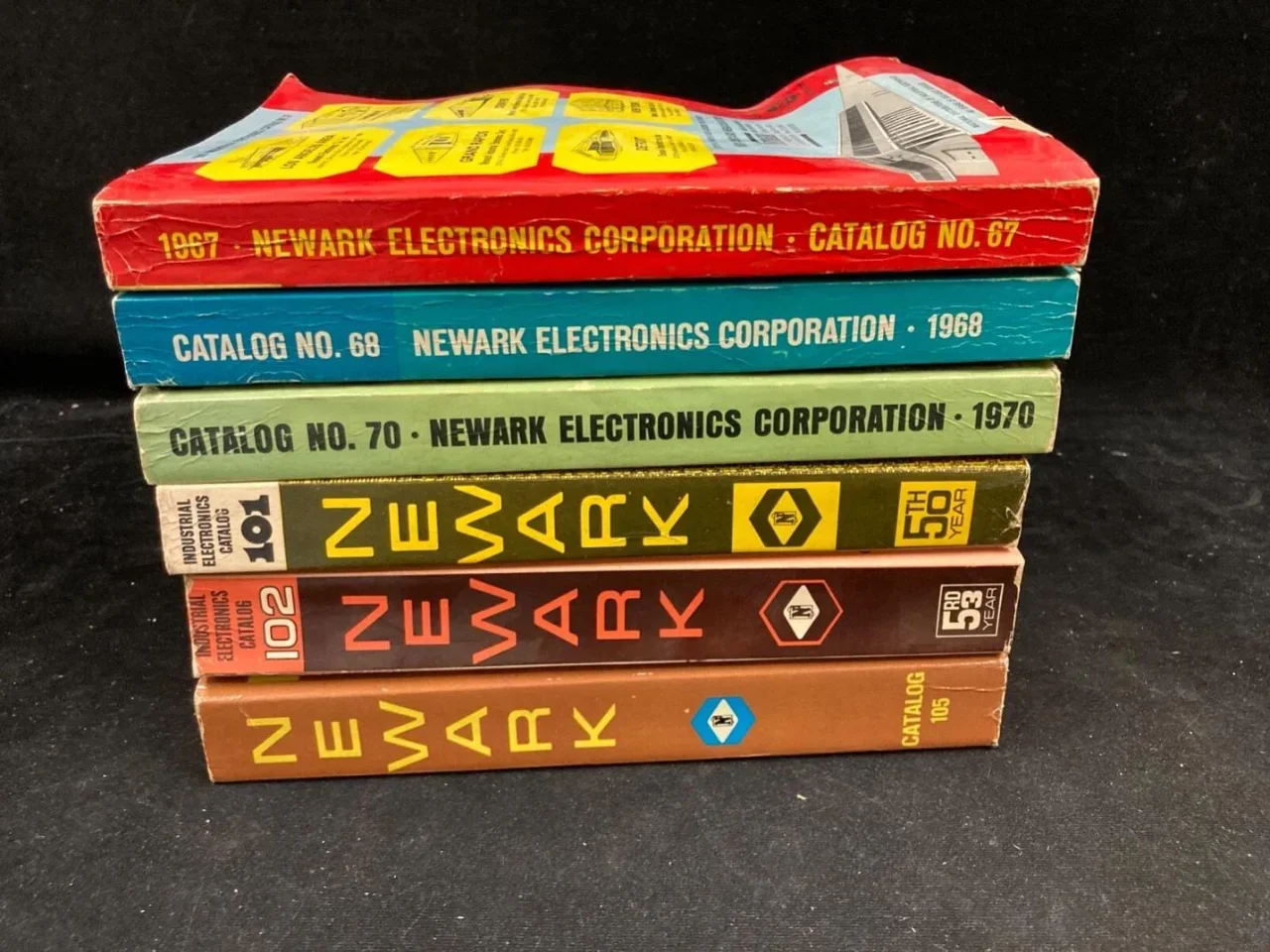
The gatekeeper had changed in form but not function. Instead of a shopkeeper’s memory, it was the catalog’s organization and the sales rep who interpreted it for you. Distributors like Newark, Allied, and Arrow competed on catalog size and shipping speed, but the funnel always ran through a human being at the distributor. Every part selection was a conversation, which meant every part selection was an opportunity to steer.
The PDF on a CD-ROM (1995–2008)
The internet changed nearly every industry overnight. It barely touched electronics.
The first wave of distributor websites were digital versions of the same catalog. Allied shipped their part list on CD-ROMs. DigiKey and Mouser set up sites where you could order parts, but only if you already had the part number. They simplified ordering, but they did little to help engineers find the right component.
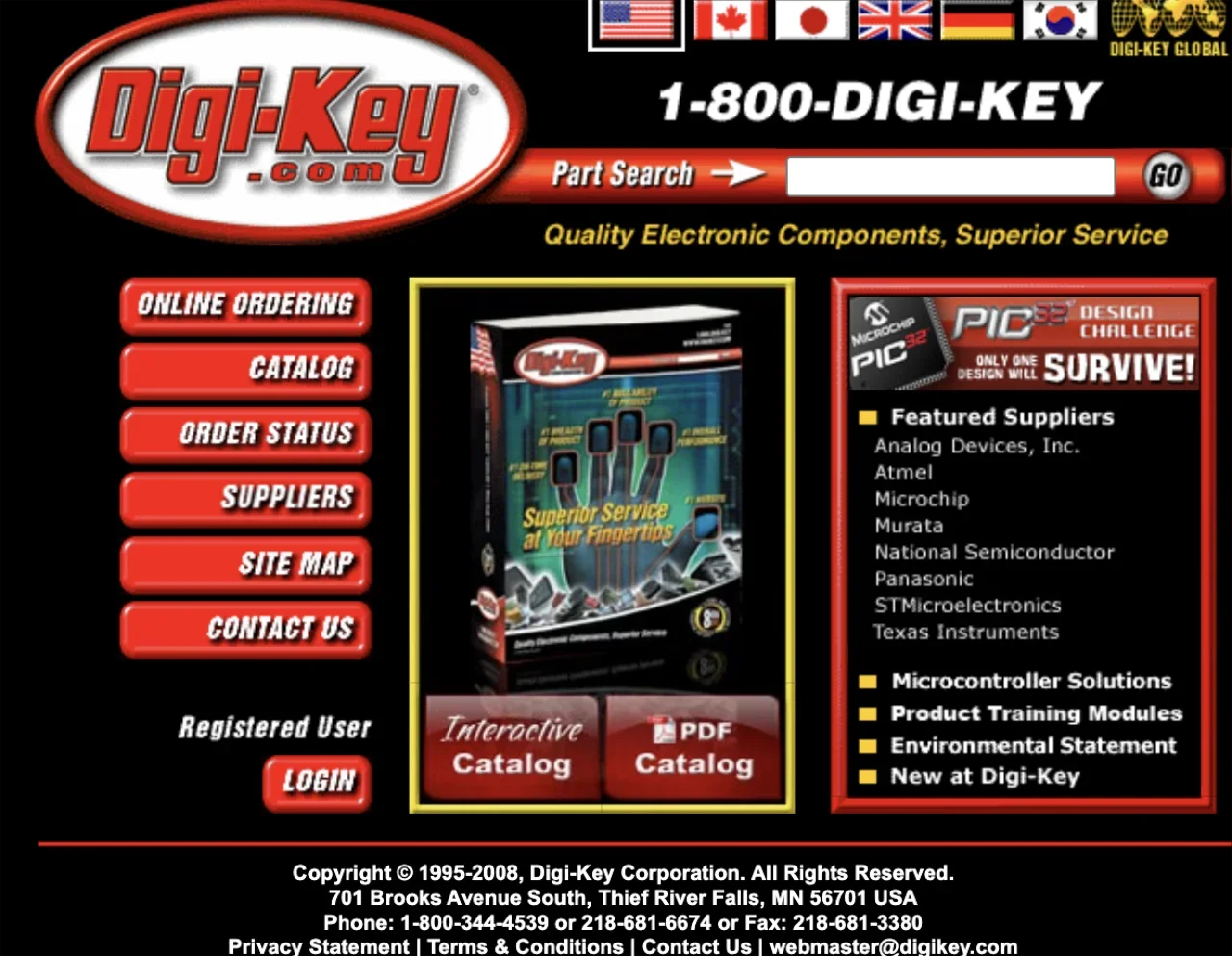
However, the technology to build a real search interface also existed at the time. Google had been indexing the entire web since 1998. Amazon had collaborative filtering. But the distributors had no reason to make self-service discovery easy. Every engineer who could find their own parts was an engineer who didn’t need to pick up the phone, and every phone call was a chance for a sales rep to push a preferred manufacturer, negotiate a volume deal, or lock in a design win.
The friction was profitable. So it stayed.
The Filter Grid (2008–present)
Parametric search finally arrived: Arrow in 2008, DigiKey in 2012. For the first time, engineers could filter a catalog by the actual specifications (voltage, current, package, temperature range) without calling anyone.
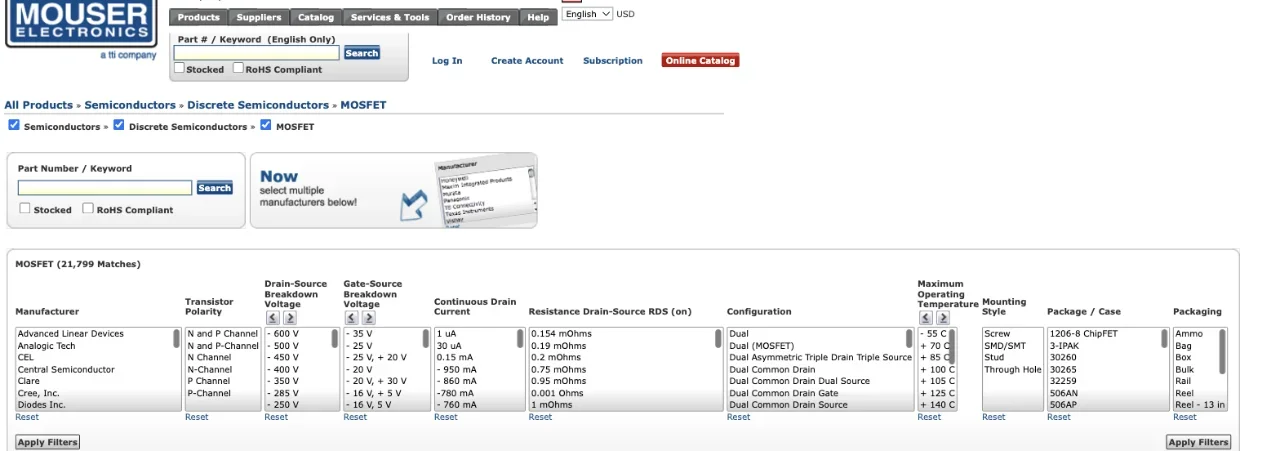
It was a genuine generational leap, and that’s why it’s still the heart of every distributor’s search flow today. But it was a decade late, and it arrived only because the dam finally broke. Engineers were already searching for part numbers online, swapping notes on forums, and building their own spreadsheets. The cost of not offering self-service had finally exceeded the cost of giving up the sales-rep funnel.
Parametric search was a revolution. It was also the last one this industry has had. And it left an enormous blind spot that most engineers bump into every week without naming it.
The 95% Problem
While parametric search was a solution to calling someone on the phone, it has also become this era’s gatekeeper. The tool can only query structured fields (voltage, capacitance, package size), which correspond to specs that someone at the distributor side has typed into a database. That covers roughly five percent of the information on a datasheet.
The other 95% (e.g., application circuits, thermal derating curves, qualification tables, timing diagrams, errata, reference designs) is locked in PDFs. Millions of pages of technical documentation that no filter grid could reach.
Consider an engineer that needs a “low-noise 3.3V low-dropout (LDO). In addition, the component needs:
- A good power supply rejection ratio (PSRR) above 1MHz
- To be automotive qualified
- To be in a thermally-enhanced package
In a situation like this, parametric search gets them to maybe a hundred candidates. Determining which of those actually fits requires opening each datasheet and reading it. For complex selections, that can mean hours of work that have little to do with the design itself.
Capabilities and Limitations of Parametric Search
| What Parametric Search Covers | What Parametric Search Misses |
| Voltage, current, and capacitance values | Application circuits and design examples |
| Package size and package type | Thermal derating curves |
| Temperature range | Qualification and compliance tables |
| Lifecycle status | Timing diagrams and errata |
| Pricing and stock availability (via distributors) | Reference designs and implementation guidance |
Why AI Component Search Works Today
Language models have now made the retrieval problem solvable in a different way. Rather than relying on what a model absorbed during training, the useful approach is an infrastructure that reads actual datasheets, indexes actual specifications from documentation, and returns results grounded in real sources.
Zenode is one example of what finding electronic components looks like when that infrastructure exists. A natural-language query: “low-noise 3.3V (LDO), Small Outline Transistor – 23 (SOT-23), 500mA, automotive grade” returns a list of parts with specific noise figures, each linked to the exact page and paragraph in the source datasheet, searching across millions of indexed parts and their documentation.
During beta testing, Zenode’s results have included:
- A robotics startup that found a drop-in replacement for a component at half the cost.
- A grad student building an ionosphere weather instrument who needed an analog-to-digital converter (ADC) specific enough that the query returned exactly one part
- A hobbyist finding replacement components for an Atari system off the market since 1976,
The Future of Component Search
For a hundred years, finding electronic components has been shaped by whoever controlled the catalog. Shopkeepers controlled access through personal knowledge. Distributors controlled it through sales relationships. Even the shift to parametric search left the deepest layer of component information locked in unstructured documents.
Each transition has happened when the cost of the old friction outweighed the benefit to the people maintaining it. The amount of information on modern datasheets has outgrown what any filter grid can expose, and the tools to search unstructured technical documentation have caught up enough to be useful.
AI will change how finding electronic components works. More interesting is what engineering looks like when the right part is reliably findable: less time spent reading PDFs, more time spent on the design itself. Experience this shift today with Zenode, an AI-powered search engine that indexes millions of datasheets so you can stop hunting for data and get back to building.
Working with Ultra Librarian sets your team up for success, ensuring streamlined and error-free design, production, and sourcing. Register today for free.


 If you’re looking for any of our component footprints or models, we have readily available and free options for you and your design team. Search our library for the solution you’ve been looking for.