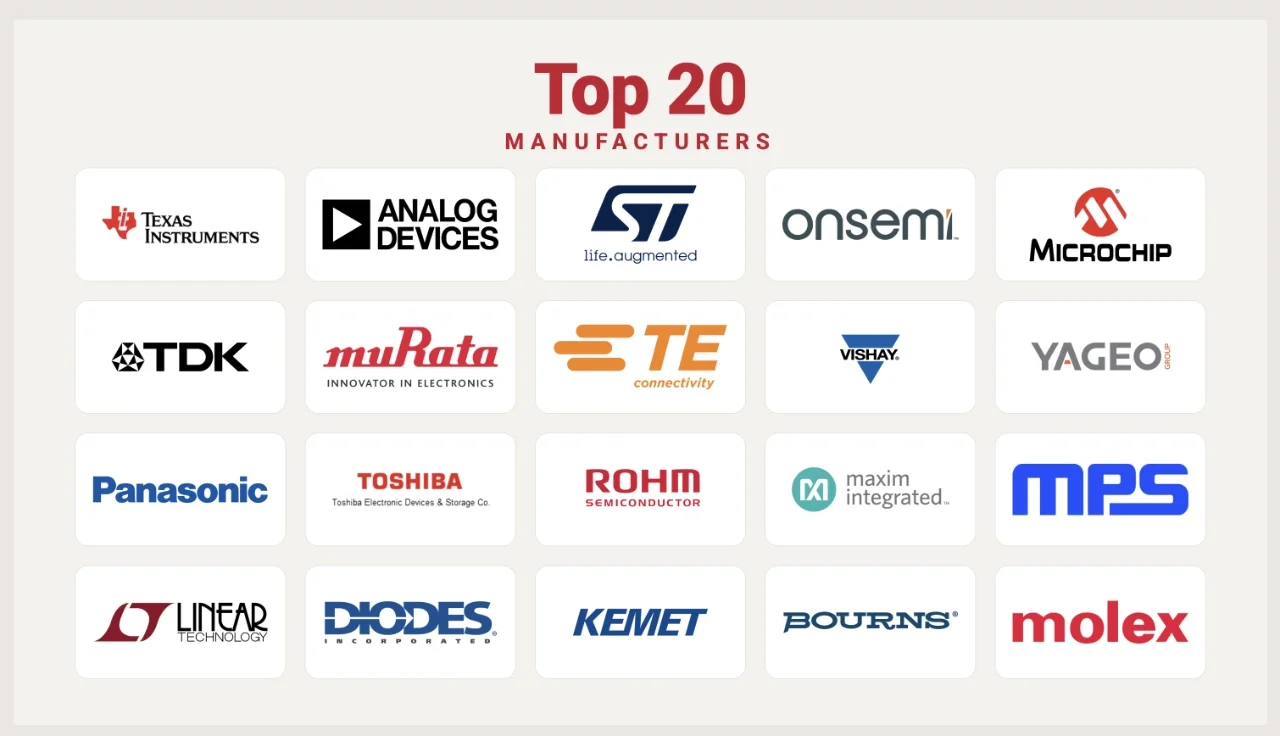
Sourcing the right integrated circuit (IC) for a new board starts before a part number lands in a bill of materials. Engineers need to know which suppliers are actually shipping volume, which package families they are standardizing on, and whether verified CAD data exists for the part they want to specify. Some of the leading IC component manufacturers in 2026 we’ll focus on in this article are Texas Instruments, STMicroelectronics, Analog Devices, Toshiba, TDK, Vishay, and TE Connectivity.
These manufacturers span analog and power ICs, discrete semiconductors, passives, sensors, and connectors. Together, they cover most of what shows up on a modern bill of materials, and each is pushing a distinct innovation focus this year.
The Leading IC Component Manufacturers in 2026
Market position for these seven varies by segment, but each holds a clear leadership role in its category.
| Manufacturer | Component Focus | 2026 Highlight |
| Texas Instruments | Analog and embedded processing | Expanding 300 mm wafer capacity for automotive, industrial, and AI data center power demand |
| STMicroelectronics | Power discretes, automotive MCUs, MEMS | Fourth-generation STPOWER SiC MOSFETs and the Stellar P3E automotive MCU with built-in AI acceleration |
| Analog Devices | Precision analog, mixed-signal, power management | Data center revenue accelerating on AI server power delivery; acquiring Empower Semiconductor for high-density power |
| Toshiba | Discrete power semiconductors, photocouplers | Continued rollout of automotive-grade MOSFETs, IGBTs, and isolators for EV and industrial power systems |
| TDK | Passive components, magnetics, sensors | Record sales driven by MLCCs and inductors for AI servers, alongside automotive and industrial sensor growth |
| Vishay | Discrete semiconductors and passives | New SiC MOSFET power modules and automotive-grade optocouplers for high-voltage EV and solar systems |
| TE Connectivity | Connectors and sensors | Expanding high-speed, high-density connectivity and liquid-cooled power solutions for AI data center infrastructure |
Innovation Focus and Package Diversity by Manufacturer
Package selection has become more varied as these manufacturers balance thermal performance, board space, and cost across different product lines.
Power and Analog ICs
Texas Instruments (TI), STMicroelectronics, Analog Devices, Toshiba, and Vishay all excel in power delivery this year from different angles.
- TI is investing heavily in internal 300 mm wafer capacity to keep analog and embedded processing lines ahead of demand, including power stages for AI servers.
- STMicroelectronics and Toshiba are both scaling silicon carbide (SiC) and discrete power devices for EV traction inverters and industrial motor drives.
- Vishay ships one of the largest combined portfolios of discrete power semiconductors and passives in the industry.
- Analog Devices is pushing further into data center power delivery, with hot-swap controllers and 800 V architectures for hyperscale racks.
Typical packages across this group range from TO-247 and D2PAK for power discretes to SOT-227 for power modules and LQFP or QFN for analog and embedded processing ICs.
Passives, Sensors, and Connectors
TDK and TE Connectivity round out the board.
- TDK supplies the multilayer ceramic capacitors (MLCCs), inductors, and magnetic components keeping pace with rising AI server demand, plus micro-electromechanical systems (MEMS) sensors through its InvenSense brand.
- TE Connectivity supplies the connectors, cable assemblies, and sensors moving power and signal between boards in AI data centers and vehicles.
These parts carry their own footprint conventions, from 0402 and 0201 chip capacitors to board-to-board connector housings and LGA sensor packages, each with clearance and creepage requirements differing from a standard IC footprint.
Why Library Quality Matters for These Manufacturers’ Parts
A manufacturer’s portfolio size makes library coverage a real engineering constraint for even the leading IC component manufacturers in 2026. Texas Instruments alone offers more than 45,000 analog products, and Vishay’s discrete and passive catalog is similarly vast. At this scale, no engineering team can hand-verify every footprint before it’s needed, which puts the burden on the library data itself to be right the first time.
The margin for error here is slim: when a symbol, footprint, or 3D STEP model does not match the datasheet exactly, risk is introduced. For example, pad geometry errors cause clearance violations and thermal simulation errors, and in the worst case, a board respin after fabrication. A manufacturer can lead its segment and still lose a design-in over a footprint failing to match its own datasheet.
What challenges do these manufacturers face in getting new parts adopted? Three show up most often:
- Portfolio growth: more package variants per product line means more footprints to validate before a part is layout-ready.
- Adoption friction: engineers default to familiar parts when a new component lacks verified CAD data, which slows design-in for genuinely better silicon.
- Visibility: without a searchable, verified library entry, a new part goes unnoticed, no matter how strong its datasheet reads.
How Manufacturer-Library Collaboration Benefits Engineers
Manufacturers pairing a new part launch with verified CAD data close a gap engineers feel immediately.
- Faster design-in: engineers drop a verified symbol and footprint straight into layout instead of building one from a datasheet by hand.
- Fewer respins: pad geometry matching manufacturer specifications catches clearance and thermal problems in simulation, not after fabrication.
- Stronger visibility: a library listing puts a new part in front of engineers actively searching for a component with its exact footprint, benefiting supplier marketing teams as much as the design engineers they are trying to reach.
Sourcing CAD Data From the Leading IC Component Manufacturers in 2026
Tracking market position and innovation focus only solves half the problem. Design teams still need accurate, ready-to-use CAD data for the specific package variant they choose from any of the leading IC component manufacturers in 2026 have to offer.
Ultra Librarian provides vendor-verified symbols, footprints, and 3D/STEP models for the leading IC component manufacturers in 2026, compatible with popular ECAD applications such as Altium, OrCAD, KiCad, and EAGLE. Every model is sourced directly from worldwide distributors and manufacturer libraries, so pad geometry and thermal data match the datasheet the first time. For engineers, it means fewer respins and faster time to a working board.
Working with Ultra Librarian sets your team up for success, ensuring streamlined and error-free design, production, and sourcing. Register today for free.

 If you’re looking for any of our component footprints or models, we have readily available and free options for you and your design team. Search our library for the solution you’ve been looking for.